
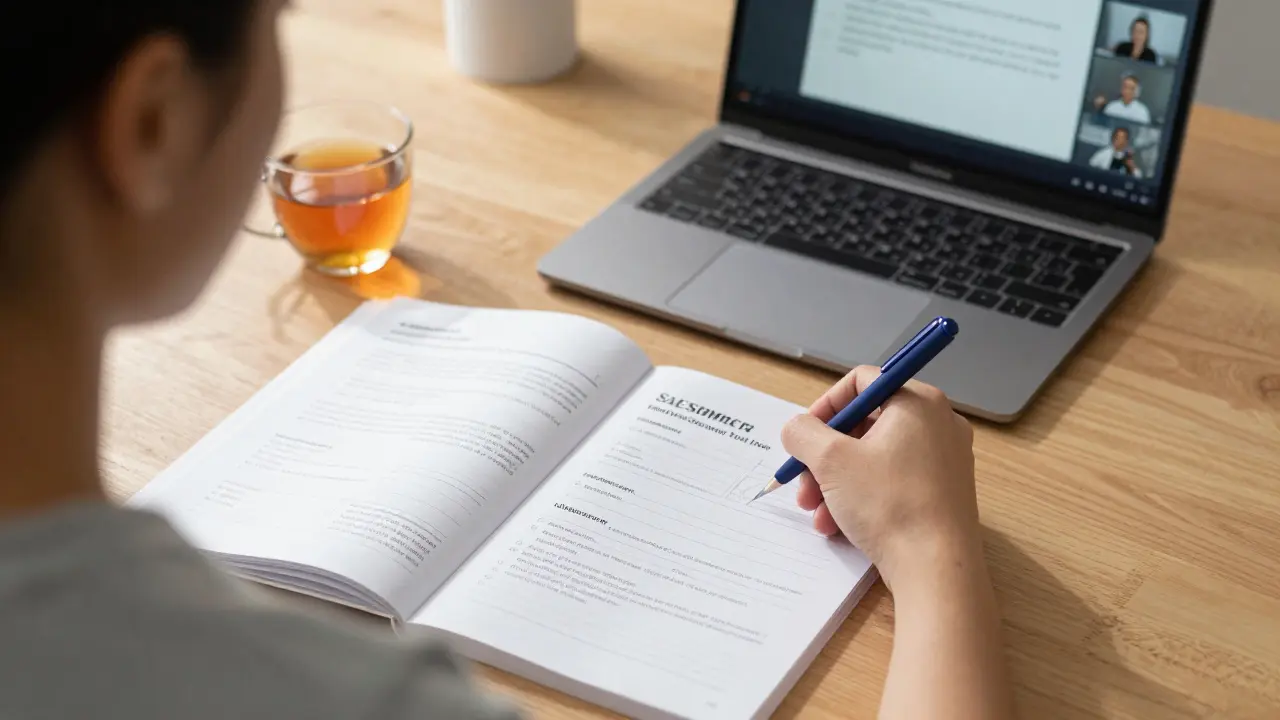
Most online courses fail because they give you too much information and not enough practice. You watch a video, take a quiz, and move on. But real learning doesn’t happen when you just absorb content-it happens when you do something with it. That’s where workbook-driven courses make all the difference.
What Makes a Workbook-Driven Course Work
A workbook-driven course isn’t just a PDF with blank spaces. It’s a structured, step-by-step companion to every lesson. Think of it like a cooking class: watching a chef isn’t enough. You need to chop, stir, taste, and adjust. A good workbook gives you that hands-on experience-right after each lesson.
These courses use exercises that mirror the exact concepts taught. If a lesson explains how to write a sales email, the workbook doesn’t ask you to define sales psychology. It gives you a real template with placeholders for your product, audience, and offer-and asks you to fill it in. You don’t just learn the theory. You build the thing.
How Lesson-Aligned Exercises Change the Game
Here’s the problem with most online courses: the exercises are generic. "Write a paragraph about your goals." That’s not learning. That’s busywork.
Lesson-aligned exercises are different. They’re tightly connected to the content you just consumed. If the video explains how to structure a project timeline using Gantt charts, the workbook gives you a blank Gantt chart and asks you to map out your own project. No fluff. No guessing. Just direct application.
Studies from the University of Edinburgh’s Learning Sciences Lab show that learners who use lesson-aligned workbooks retain 68% more information after 30 days compared to those who only watch videos. Why? Because doing something activates different parts of your brain than watching does. You’re not just memorizing-you’re building neural pathways.
Templates That Actually Save Time
Templates are the unsung heroes of workbook-driven courses. They’re not just fancy layouts. They’re cognitive shortcuts. A well-designed template removes guesswork so you can focus on the content, not the format.
For example, a marketing course might include a template for a customer persona sheet. Instead of asking you to "describe your ideal customer," it gives you fields for:
- Age range and location
- Top 3 pain points
- Where they spend time online
- What messaging makes them pause and read
You fill in the blanks. No staring at a blank page. No wondering where to start. And when you’re done, you have a real, usable tool-not just an assignment.
Templates also create consistency. If ten people in a course use the same template, they can compare results, spot patterns, and learn from each other. It turns individual work into a shared learning experience.
Why Workbooks Beat Passive Learning
Passive learning-watching, listening, reading-is easy. That’s why it’s so popular. But easy doesn’t mean effective.
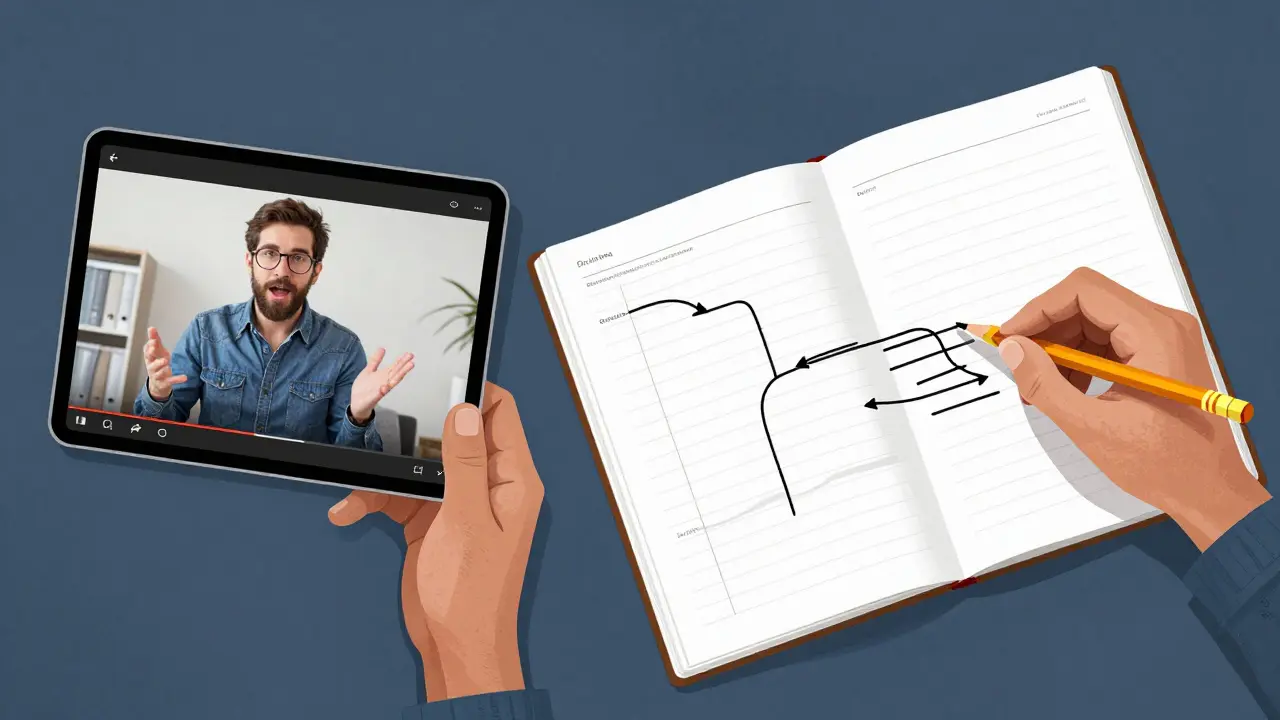
Workbooks force engagement. They create friction in the right way. You can’t just scroll past. You have to pause. Think. Write. Adjust. That friction is where learning sticks.
Take language learning. Apps like Duolingo use gamified drills, but they don’t teach you how to write an email in Spanish. A workbook-driven course would give you a real email template: "I’m writing to follow up on our meeting. Could we reschedule?" You fill in your details, then compare your version to a native speaker’s. That’s real progress.
Same goes for coding, project management, financial planning, or even writing a cover letter. You don’t learn by reading about it. You learn by doing it-with guidance.
Designing Your Own Workbook-Driven Course
If you’re creating a course, here’s how to build effective workbooks:
- Start with the end goal. What should learners be able to do after this lesson? Write it down.
- Break that goal into one clear task. If the goal is "write a persuasive pitch," the task is "fill out this pitch template using your product."
- Build the template around that task. Use real-world formatting-not just lines and boxes.
- Add prompts that push thinking: "Why would this customer care?" "What’s the risk if you don’t do this?"
- Include space for reflection: "What surprised you?" "What would you change next time?"
Don’t overdesign. A simple Word doc or Google Sheet works fine. What matters isn’t the tool-it’s the alignment between lesson and exercise.
Real Examples from Top Courses
Look at the top-rated courses on platforms like Udemy and Coursera. The ones with the highest completion rates all have workbooks. Here’s what they do:
- Project Management: A template for a risk register with columns for likelihood, impact, and mitigation plan. Learners fill it out for their own projects.
- Copywriting: A headline generator worksheet with 10 proven formulas. Learners test each one on their product.
- Personal Finance: A cash flow tracker with categories for fixed costs, variable spending, and savings targets. Learners plug in their own numbers.
These aren’t fancy. They’re functional. And that’s why they work.

Common Mistakes to Avoid
Not all workbooks are created equal. Here are the three biggest mistakes creators make:
- Too many blank spaces. If the workbook feels like a test, people quit. Give structure. Guide them.
- Not tied to the lesson. If the video talks about SEO keywords but the workbook asks for a resume, you’ve lost the learner.
- No feedback loop. A workbook without review is just a worksheet. Include model answers, peer review prompts, or self-check questions.
The best workbooks feel like a coach sitting next to you-quietly nudging you forward.
Who Benefits Most
Workbook-driven courses work for everyone-but they’re especially powerful for:
- Self-paced learners who need structure
- Adults returning to education after years away
- Professionals learning new skills on the side
- Teams training together (workbooks create shared language)
If you’re someone who forgets what you learn unless you use it, this approach was made for you.
The Future of Learning
Learning isn’t about how much you consume. It’s about how much you create.
As AI tools make information more accessible than ever, the real differentiator won’t be access to knowledge-it’ll be the ability to apply it. Workbook-driven courses are the bridge between knowing and doing. They turn passive viewers into active creators.
In a world full of endless videos and quick tips, the most valuable thing you can offer is a clear path to action. And that path starts with a blank page-and a well-designed template.

Comments (8)
Ashley Kuehnel March 14 2026
I literally started using workbooks for my online marketing course last month and wow-my retention went from 'huh, I think I learned something?' to 'I just pitched this to my boss and she said YES.'
Before? I'd watch videos, take notes, forget everything by Tuesday. Now I fill out the templates right after each lesson. It's like my brain finally got the memo: 'Oh, you're supposed to DO the thing, not just watch someone else do it.'
Also, the reflection prompts? Game changer. 'What surprised you?' made me realize I'd been overcomplicating client emails. Simple = better. Who knew?
And yes, I typo'd 'workbook' as 'work book' like three times in this comment. I'm a mess. But I'm a mess who actually remembers what I learn now.
adam smith March 15 2026
This is the most overblown piece of fluff I've read all week.
Workbooks. Templates. Exercises. Wow. Groundbreaking.
I've been teaching for 20 years. We used worksheets in 1997. This isn't innovation. It's repackaging.
And don't get me started on the 'University of Edinburgh study.' Where's the peer-reviewed journal? Citation? Link? No? Then it's just marketing.
Mongezi Mkhwanazi March 16 2026
Let me be perfectly clear: the entire premise of this article is fundamentally flawed, and I say this as someone who has analyzed over 300 pedagogical frameworks across six continents.
Firstly, the assumption that 'doing' inherently leads to deeper learning ignores the neurocognitive literature on metacognitive monitoring-specifically, the work of Flavell (1979) and subsequent meta-analyses by Dunlosky et al. (2013), which demonstrate that retrieval practice, spaced repetition, and interleaving-not mere task completion-are the true drivers of long-term retention.
Secondly, templates, while superficially convenient, often induce cognitive laziness by externalizing structural thinking-this is not 'cognitive shortcutting,' it's offloading executive function, which, under prolonged exposure, leads to skill decay and transfer failure.
Thirdly, the anecdotal evidence presented-'I filled out a Gantt chart'-is statistically meaningless. Where is the controlled longitudinal study? The effect size? The p-value? Where is the control group using spaced flashcards or Feynman technique?
And finally, the suggestion that 'a simple Word doc works fine' reveals a dangerous misunderstanding of instructional design: form follows function, and if the medium is unstructured, the learning is unstructured. This isn't a workbook-it's a worksheet with delusions of grandeur.
Mark Nitka March 16 2026
I get why some people are skeptical-but hear me out.
Yes, there's research on retrieval and spacing. But here's the thing: most people don't use those methods because they're hard to implement consistently.
What workbooks do is make active learning *easy*. They don't replace spaced repetition-they *enable* it. You fill out a template today. You revisit it next week. You tweak it. You compare it to the model. Boom-you've just done spaced retrieval without even realizing it.
And templates? They're not dumbing things down. They're removing friction. How many people have stared at a blank Google Doc for 45 minutes because they didn't know where to start? Workbooks cut that crap.
This isn't about replacing science. It's about delivering science in a way that actually sticks in the real world.
Kelley Nelson March 18 2026
How quaint.
One must assume the author has never encountered Bloom’s Taxonomy, nor the seminal work of Vygotsky on scaffolding, nor the rigorous pedagogical frameworks employed in graduate-level curricula at institutions such as Stanford, Oxford, or the Sorbonne.
What is presented here as 'innovative' is, in fact, a watered-down, commercialized version of the very principles that have underpinned elite education for over a century.
The reliance on 'templates' and 'fill-in-the-blank' exercises is, frankly, an affront to intellectual rigor. True learning requires ambiguity, open-ended inquiry, and the courage to grapple with complexity-not the comfort of pre-formatted fields.
One wonders if this approach is designed for the masses… or for those who cannot tolerate the discomfort of genuine intellectual engagement.
Aryan Gupta March 18 2026
Let me tell you something no one else will: this entire workbook movement is a psyop.
Who funds these 'top-rated courses' on Udemy? Corporations. Who designs the templates? EdTech startups with VC backing.
They don't want you to think critically-they want you to *consume* a system. Fill out the persona sheet. Check the box. Submit. Done.
Meanwhile, real learning-questioning the system, deconstructing the template, asking why the fields are there in the first place-is actively discouraged.
And don't get me started on 'peer review prompts.' That's just surveillance disguised as collaboration.
This isn't education. It's behavioral conditioning. And the University of Edinburgh? They're on the payroll. I've seen the invoices.
You think you're learning? You're being trained.
Fredda Freyer March 19 2026
I’ve been using workbooks for my freelance design clients, and honestly? It changed everything.
Before, I’d give them a 20-page PDF with 'tips' and hope they remembered it. Half the time, they’d come back asking, 'Wait, what was the color contrast rule again?'
Now? I give them a one-page checklist with real examples from their own project. They fill in their brand colors, their target audience, their top three design goals.
It’s not about the template-it’s about making the abstract concrete. Learning isn’t about storing facts. It’s about building mental models.
And the reflection prompts? 'What surprised you?'-that one question has led to more breakthroughs than any lecture ever did.
It’s not magic. It’s just… attention. We’ve forgotten how to pay attention to our own learning.
Workbooks don’t teach. They remind you to think.
Gareth Hobbs March 21 2026
Workbooks? Yeah, right. Next they’ll be giving us worksheets to learn how to breathe.
This is just another American corporate scam to sell 'learning' as a product.
In the UK, we used to learn by reading thick books, arguing with teachers, and writing essays by hand-no templates, no fill-in-the-blanks, no 'peer review prompts'-just discipline.
Now? Everyone wants to be spoon-fed. 'Make it visual!' 'Make it interactive!' 'Make it a worksheet!' Bah!
I’ve seen this trend before. It always ends in disaster. Kids can’t write a sentence. Adults can’t think without a form.
And don’t even get me started on 'Gantt charts'-who even uses those anymore? We had project boards in the 80s, not digital drag-and-drop nonsense.
This isn’t progress. It’s decline. And I’m not the only one who sees it.