
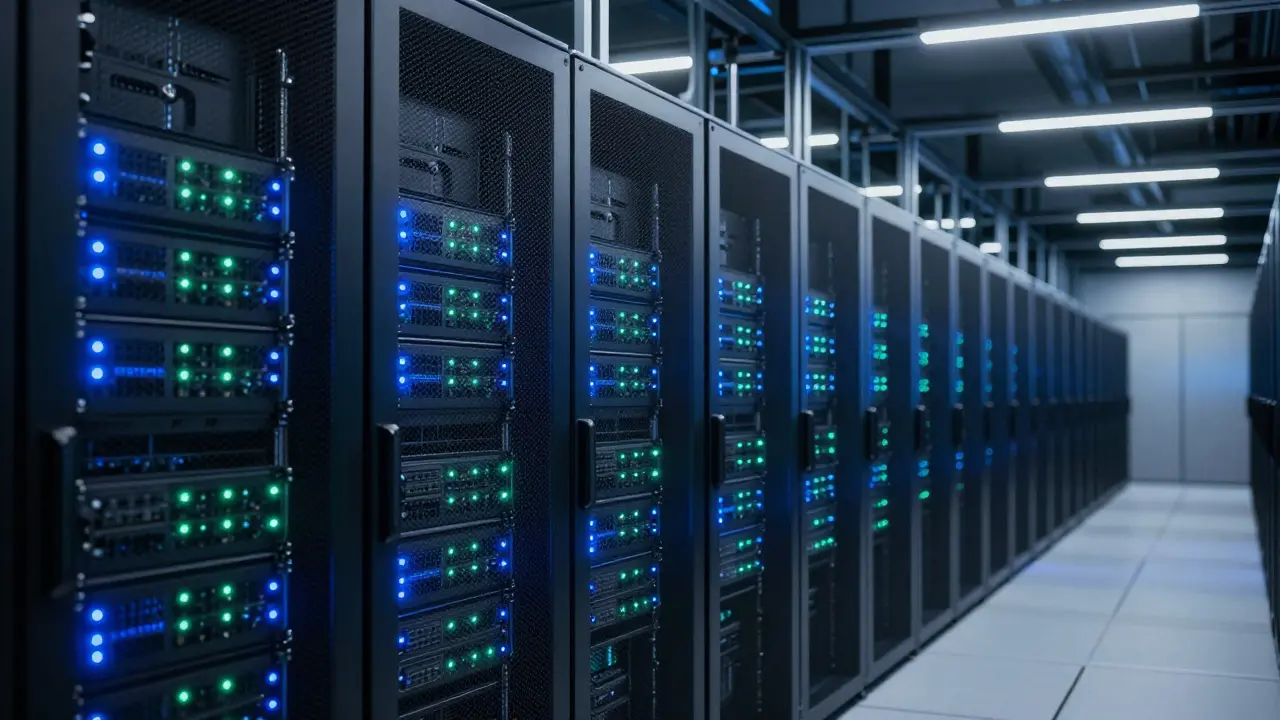
Imagine running a massive server farm where every transaction you process costs you not just money in hardware, but also electricity that heats up the planet. That is the reality for modern digital infrastructure. We are used to asking how fast a system is-how many transactions it can handle or how much data it can move-but we rarely ask what that speed costs in terms of energy. This is where network efficiency metrics like Transactions Per Second per Watt (TPS/W) and throughput per watt come into play. They measure the actual value you get from every joule of power consumed.
In 2025, global data centers were projected to consume around 536 TWh of electricity, roughly 2% of the world's total output. By 2023, U.S. data centers alone were using about 176 TWh, which is 4.4% of national electricity demand. These numbers are climbing fast due to AI workloads and blockchain activity. If we keep building faster systems without making them more efficient, we will hit physical limits on power supply and cooling. Tracking efficiency isn't just an environmental checkbox; it is a hard engineering constraint.
The Core Concept: Performance Per Watt
To understand these specific metrics, you need to look at the broader idea of performance per watt. This concept was formalized in computing literature as early as 2008 and has become the gold standard for evaluating hardware efficiency. The basic math is simple: take the amount of useful work done (operations, bits, or transactions) and divide it by the power consumed in watts. A higher number means you are getting more work out of less energy.
Performance Per Watt (PPW) is the ratio of computational or network performance to electrical power consumption, serving as a primary indicator of energy efficiency in hardware systems. It allows engineers to compare servers, GPUs, and network switches on a level playing field, regardless of their absolute size or cost.
In traditional computing, this might mean floating-point operations per second per watt. In networking, it shifts to bits per second per watt. And in blockchains, it becomes transactions per second per watt. The underlying principle remains the same: efficiency is king when power budgets are tight.
Measuring Network Throughput Efficiency
For routers, switches, and general data networks, the industry is moving toward standardized metrics proposed by bodies like the Internet Engineering Task Force (IETF). In late 2024, an IETF draft introduced two key measures: Network Equipment Energy Efficiency (NEEE) and Power Consumption per Data Rate (PCDR).
- NEEE (bps/W): This measures how many bits per second a device can handle for every watt it uses. For example, if a switch processes 10 Gbps while drawing 200 W, its NEEE is 50 Mbps/W.
- PCDR (W/Gbps): This is the inverse, showing how many watts are needed to push one gigabit per second. Using the same example, the PCDR would be 20 W/Gbps.
These metrics help IT managers choose equipment that doesn't just move data fast, but does so without blowing the budget on electricity. A router handling 40 Gbps at 400 W (1e9 bps/W) is significantly more efficient than an older model doing 80 Gbps at 300 W (2.67e8 bps/W), even though the newer one moves less total data.
Blockchain Efficiency: TPS per Watt
Blockchains have long been criticized for high energy use, particularly Proof-of-Work networks like Bitcoin. However, newer chains focus heavily on scalability, often measured in Transactions Per Second (TPS). But raw TPS can be misleading. A chain might boast thousands of TPS in theory, but if it requires massive amounts of power to achieve that, it is inefficient.
TPS per Watt fills this gap. It calculates the number of valid transactions processed divided by the elapsed time, then divides that result by the average power draw of the node or network.
Consider the SKALE network, which reported a measured TPS of 397.7 with a time to finality of 1.46 seconds in a 2023 study. While impressive, knowing the wattage required to sustain that load gives a clearer picture of its sustainability. Similarly, the Internet Computer Protocol (ICP) reported real-time TPS figures over 1,200 in mid-2025. Without pairing these numbers with energy data, it is hard to judge true efficiency. The industry is slowly catching up, recognizing that TPS/W is the metric that matters for long-term viability.

Data Center Reality: PUE and Server Load
You cannot evaluate network efficiency in a vacuum. You have to consider the entire facility. This is where Power Usage Effectiveness (PUE) comes in. PUE is calculated by dividing the total facility energy by the IT equipment energy. An ideal PUE is 1.0, meaning all power goes directly to the servers and none is wasted on cooling or lighting.
Most modern hyperscale data centers operate with a PUE between 1.08 and 1.13. Google, for instance, reported Time-to-Market PUE values in this range in July 2026. This means that for every 1 watt delivered to a server, about 0.1 to 0.13 watts are used for support infrastructure. If you improve your server's throughput per watt, you save energy at the source, which cascades through the whole facility. Saving 100 W at the server level in a PUE 2.0 environment saves 200 W at the grid level.
Different workloads have different power profiles. Video streaming servers might draw 200-400 W each, while AI/ML workloads can exceed 600 W per server. Blockchain nodes often sit in the 400-600 W range. Knowing the baseline power draw helps you calculate accurate efficiency metrics.
Edge AI and Alternative Metrics
The concept of efficiency per watt extends beyond traditional networks and blockchains. In edge AI, where devices run on batteries, the metric is often Tokens Per Second per Watt. Here, user experience depends on responsiveness, not just raw speed. A system delivering 20 tokens per second at 4 watts (5 tokens/s/W) is often better for a handheld device than one delivering 25 tokens per second at 10 watts (2.5 tokens/s/W), because it lasts longer on a single charge.
Similarly, video streaming companies are adopting "Watts per Stream" as a strategic KPI. If a system delivers 1,000 streams at 2,000 W, that is 2 W/stream. Another system doing the same at 3,000 W is 3 W/stream. The first one is clearly more efficient, regardless of how many servers it uses. These domain-specific metrics all stem from the same root: normalizing performance against energy cost.

How to Calculate Your Own Metrics
If you want to track these metrics in your own infrastructure, you need synchronized measurements of performance and power. Here is a practical approach:
- Define the Workload: Use a consistent packet size for networks or a standard transaction type for blockchains. Variable loads make comparisons invalid.
- Measure Power Accurately: Use calibrated power supplies or intelligent PDUs to record wattage at the point of delivery to the device, not just the wall outlet.
- Capture Performance: Record throughput (bps) or transactions (TPS) over the same time window as the power measurement.
- Calculate the Ratio: Divide performance by power. For TPS/W, it is simply TPS / Watts.
Red Hat’s 2026 case study on x64 servers demonstrated this well. They measured a 32-core server with 100 GbE NICs. At full load, the system achieved 24,287 Mbps while drawing 210 W, resulting in 115.65 Mbps/W at the system level. Interestingly, they found that adding more cores didn't always improve efficiency; sometimes throughput rose only 10% while power jumped 30%, causing the Mbps/W ratio to fall. This highlights diminishing returns and the importance of tuning rather than just scaling up.
| Scenario | Throughput/TPS | Power Draw | Efficiency Metric |
|---|---|---|---|
| Legacy Router | 40 Gbps | 400 W | 100 Mbps/W |
| Modern Switch | 100 Gbps | 300 W | 333 Mbps/W |
| Blockchain Node A | 500 TPS | 250 W | 2 TPS/W |
| Edge AI Device | 30 Tokens/s | 3 W | 10 Tokens/s/W |
Why This Matters for Sustainability
We are approaching a tipping point. Deloitte forecasts that global data center electricity use could reach 536 TWh in 2025. If U.S. consumption doubles to 352 TWh within a decade, the strain on the grid will be immense. Improving throughput per watt by even 10% could save tens of TWh annually. This is not just about saving money; it is about keeping digital services viable in a world with finite energy resources.
Regulators and investors are starting to pay attention. Companies that can prove high efficiency through audited metrics like NEEE or TPS/W will have a competitive advantage. They will face lower operational costs, reduced carbon footprints, and better compliance with emerging ESG standards. As hardware vendors begin marketing PPW alongside raw speed, procurement teams will shift their focus from "fastest" to "most efficient."
Future Outlook and Standardization
The next few years will see these metrics move from niche engineering discussions to boardroom KPIs. The IETF’s work on NEEE and PCDR is expected to gain wider adoption between 2025 and 2027. Streaming companies may start reporting Watts per Stream publicly. Blockchain protocols will likely integrate energy audits into their consensus mechanisms. The goal is clear: decouple digital growth from energy consumption. By tracking TPS per watt and throughput efficiency, we ensure that our digital future is both powerful and sustainable.
What is TPS per Watt?
TPS per Watt is a metric that measures the number of valid transactions a system, typically a blockchain network, can process per second for every watt of electrical power it consumes. It is calculated by dividing the Transactions Per Second (TPS) by the average power draw in watts.
How do you calculate Network Equipment Energy Efficiency (NEEE)?
NEEE is calculated by dividing the data throughput in bits per second (bps) by the power consumption in watts (W). For example, if a router handles 10 Gbps at 200 W, the NEEE is 50 Mbps/W. This metric helps compare the energy efficiency of different network devices.
Why is Power Usage Effectiveness (PUE) important for network efficiency?
PUE measures the total facility energy divided by the IT equipment energy. It shows how much extra power is used for cooling and lighting. A lower PUE means more of the electricity goes directly to processing data. Improving device-level efficiency (like TPS/W) has a multiplied effect on total facility savings based on the PUE.
What is the difference between TPS and TPS per Watt?
TPS measures raw speed or capacity-the number of transactions processed per second. TPS per Watt measures efficiency-it tells you how much energy is required to achieve that speed. A high TPS is useless if it consumes excessive power, making TPS/W a better indicator of sustainable performance.
How does throughput per watt apply to Edge AI?
In Edge AI, throughput per watt is often expressed as Tokens Per Second per Watt. Since edge devices run on limited battery power, maximizing the number of AI tokens generated per watt is crucial for maintaining long battery life and responsive user experiences, rather than just achieving peak processing speeds.
