
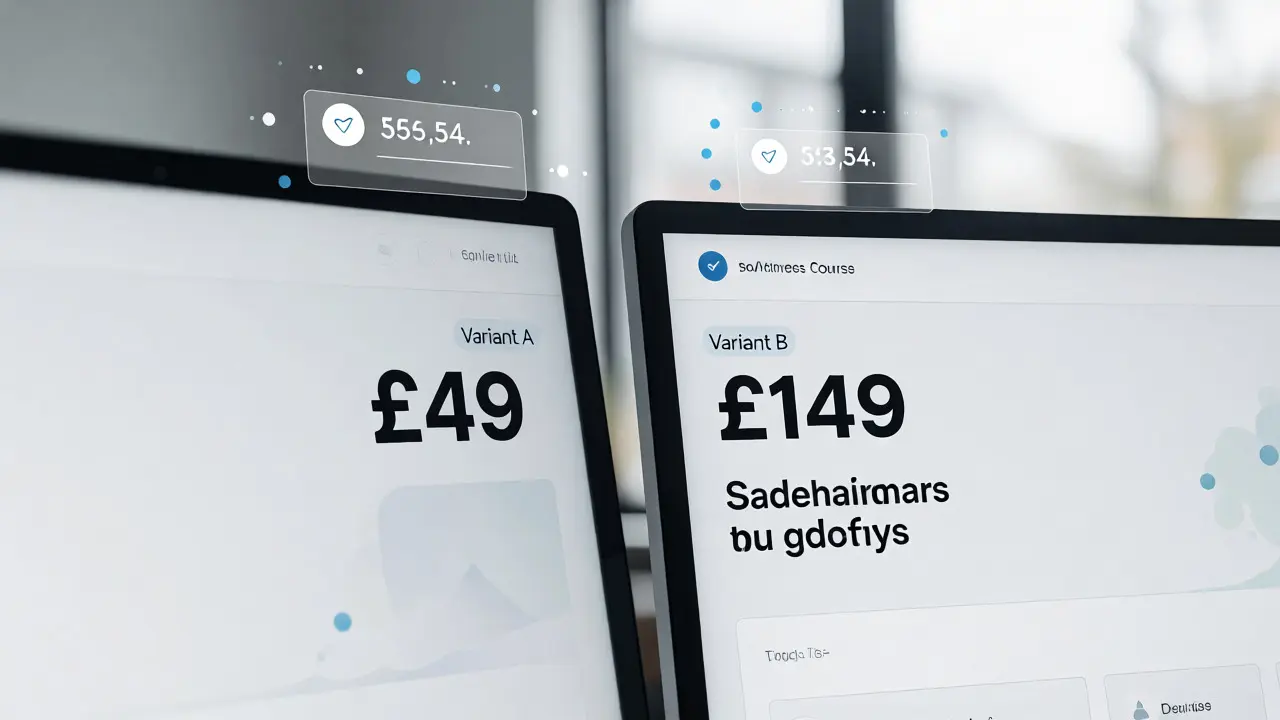
Most course creators guess their prices. They look at what competitors charge, pick a number that feels safe, and hope for the best. But here’s the problem: you might be leaving thousands of pounds on the table by charging £49 when your audience would happily pay £149. Or worse, you might be scaring people away with a £299 price tag when £199 would have doubled your sales volume.
Price testing is the systematic process of experimenting with different price points to determine which maximizes revenue or profit for a product or service. It’s not about tricking customers; it’s about finding the sweet spot where value perception meets willingness to pay. For online courses, this is critical because digital products have near-zero marginal costs-selling one more unit costs you almost nothing, so optimizing price directly impacts your bottom line.
You don’t need a PhD in economics to do this right. You need a structured approach to A/B experiments, controlled tests comparing two versions (A and B) to see which performs better against a specific metric, and an understanding of how demand changes as prices shift. Let’s break down how to run these tests without wrecking your brand trust.
Why Guessing Prices Fails for Course Creators
When you set a price based on intuition, you’re ignoring data. Human brains are terrible at estimating value. We anchor on our own effort (“I spent 50 hours making this, so it’s worth £50”) rather than customer outcome (“This saves them 100 hours, so it’s worth £500”).
Consider the concept of price elasticity, a measure of how sensitive consumer demand is to changes in price. If your course is highly elastic, a small price increase causes a massive drop in sales. If it’s inelastic, you can raise prices significantly without losing many buyers. Most beginners assume their niche is elastic because they fear rejection. In reality, specialized B2B courses often show low elasticity-professionals will pay premium rates for high-value skills if the ROI is clear.
Without testing, you’re flying blind. You might spend six months marketing a course at £97, only to discover later that £197 would have generated 30% more revenue despite selling fewer units. That’s real money lost to uncertainty.
Setting Up Your First Price Test
You can’t just change the price randomly and see what happens. You need control. The gold standard here is the A/B test, an experiment where two variants are shown to similar groups of users to compare performance. In the context of pricing, Variant A is your current price, and Variant B is the new price you want to try.
Here’s how to structure it:
- Isolate traffic: Split your incoming visitors evenly. If you use a platform like Teachable or Kajabi, many have built-in split-testing features. If not, use a tool like VWO or Optimizely to route 50% of traffic to Page A (£49) and 50% to Page B (£99).
- Keep everything else constant: Change only the price. Don’t tweak the headline, the image, or the button color at the same time. If you change multiple variables, you won’t know which one caused the shift in conversions.
- Define your metric: Are you optimizing for total revenue, profit margin, or conversion rate? Usually, revenue is the safest starting point. A higher conversion rate at a lower price doesn’t always mean more money in the bank.
One common pitfall is running the test for too short a time. People buy courses on weekends, during lunch breaks, or after work. A one-day test skews results. Run your test for at least two full weekly cycles to capture behavioral patterns. If you get 100 visitors per day, wait until you have enough statistical significance-usually around 1,000-2,000 visitors per variant-to make a decision.
Understanding Price Elasticity in Practice
Elasticity sounds academic, but it’s practical math. The formula is simple: Percentage change in quantity demanded divided by percentage change in price. If raising your price by 10% causes sales to drop by 20%, your elasticity is -2. This is considered elastic. If sales only drop by 5%, elasticity is -0.5, meaning it’s inelastic.
| Scenario | Price Change | Sales Volume Change | Elasticity Type | Revenue Impact |
|---|---|---|---|---|
| Commodity Course | +10% | -25% | Elastic (>1) | Revenue Decreases |
| Niche Skill Course | +10% | -5% | Inelastic (<1) | Revenue Increases |
| Premium Certification | +10% | -8% | Unit Elastic (~1) | Revenue Stable |
Notice how the “Niche Skill” scenario wins? Many creators underestimate their niche’s power. If your course solves a painful, expensive problem-like fixing a compliance issue for UK accountants-your audience has few alternatives. They’ll pay more. Test aggressively upward before assuming they’re price-sensitive.

Tactical Approaches Beyond Simple A/B Tests
Simple A/B tests work, but they’re slow. Here are three faster tactics used by successful educators.
The Van Westendorp Price Sensitivity Meter
This survey method asks four questions: At what price would it be so cheap you’d question its quality? At what price would it be a bargain? At what price would it start getting expensive? At what price would it be too expensive to consider? Plotting these answers helps you find the optimal price range before you even launch. It’s great for pre-launch validation when you don’t have traffic yet.
Bundling and Tiering
Instead of testing one price, test bundles. Offer a Basic tier (£49), Pro tier (£99), and VIP tier (£199). Track which tier sells most. Often, the middle option anchors the others. If everyone buys the Basic tier, your Pro tier isn’t compelling enough. If everyone buys VIP, your Basic tier is too cheap. Adjust the content gap between tiers and retest.
Launch Pricing vs. Evergreen Pricing
Your launch price shouldn’t be your forever price. Use a steep discount for the first 48 hours to gather data and social proof. Then revert to the standard price. Analyze the difference. If 80% of sales happen at the discounted rate, your perceived value might be misaligned. Consider adding bonuses instead of lowering the permanent price to maintain prestige.
Common Mistakes That Kill Profitability
I’ve seen creators sabotage their own tests. Here’s what to avoid.
Testing with biased audiences. If you send the £199 offer only to your email list and the £49 offer to cold Facebook ads, you’re not testing price-you’re testing channel quality. Email subscribers trust you more and convert at higher rates regardless of price. Always test within the same traffic source.
Ignoring refund rates. Sometimes a higher price increases refunds. People feel buyer’s remorse if they stretch their budget. Track net revenue (sales minus refunds). If your £149 course has a 15% refund rate and your £99 course has 5%, the £99 option might actually yield more stable cash flow.
Changing prices too frequently. Customers hate inconsistency. If someone sees £99 today and £49 tomorrow, they lose trust. Once you settle on a winning price, stick with it for at least 3-6 months. Use coupons for promotions rather than changing the base price.

Tools and Metrics to Watch
You don’t need enterprise software. Most major platforms support basic split testing.
- Kajabi & Thinkific: Built-in checkout splits allow you to create duplicate pages with different prices.
- Stripe Checkout: You can dynamically pass different amounts via API links for targeted campaigns.
- Google Analytics 4: Set up custom dimensions to track price variations alongside conversion events.
Key metrics to monitor:
- Conversion Rate: % of visitors who buy.
- Average Order Value (AOV): Crucial if you sell upsells.
- Customer Acquisition Cost (CAC): Ensure the higher price covers your ad spend.
- Lifetime Value (LTV): Do high-ticket buyers stay longer or buy more add-ons?
Remember, the goal isn’t just to sell more copies. It’s to maximize profit. A £200 course that sells 50 times yields £10,000. A £50 course that sells 150 times yields £7,500. Fewer students also means less support load, which improves margins further.
How to Communicate Price Changes to Existing Students
If you raise prices, existing students might feel cheated. Mitigate this by framing it as “grandfathering.” Tell them, “You locked in this rate before we updated our curriculum.” Transparency builds loyalty. Never retroactively charge more. Instead, offer them early access to the next course at the old rate as a thank-you.
For future prospects, justify higher prices with added value. Did you add live Q&A sessions? New worksheets? Updated case studies? Update your sales page copy to reflect these enhancements before launching the higher price test. Perception drives willingness to pay.
How long should I run a price test?
Run it for at least two full weeks to capture weekday and weekend behaviors. Statistically, you need enough data to reach 95% confidence. For smaller sites, this might take 4-6 weeks. Don’t stop early just because one day looks promising.
Can I test prices on paid ads?
Yes, but be careful. Paid traffic is expensive. Start with organic or email traffic to validate the price point cheaply. Once you know the winning price, apply it to paid campaigns to ensure your Return on Ad Spend (ROAS) remains profitable.
What if my audience reacts negatively to a price hike?
Negative reactions often stem from poor communication, not the price itself. Explain the value increase. Also, check if the price jump was too drastic. Incremental increases (e.g., 10-20%) are easier to digest than doubling the price overnight.
Does price testing work for free-to-paid funnels?
Absolutely. Test the entry-point price for your tripwire product. Small changes in the initial purchase price can dramatically affect downstream lifetime value if the free-to-paid conversion rate holds steady.
Should I use psychological pricing like £97 vs £100?
Test it. While £97 often outperforms £100 due to left-digit bias, some premium audiences prefer round numbers as they signal quality. Include both variants in your A/B test to see which resonates with your specific demographic.

Comments (1)
Erin Zimmerman November 4 2026
most people are too lazy to actually do the math so they just guess and lose money