

When you deposit crypto into a DeFi lending platform, you might think your assets are locked safely in your own vault-untouched, isolated, and secure. But what if that vault isn’t really isolated at all? What if the platform you trust is quietly using your collateral to back someone else’s loan-and then someone else’s again? This is rehypothecation, and it’s one of the most dangerous hidden risks in DeFi today.
What Exactly Is Rehypothecation?
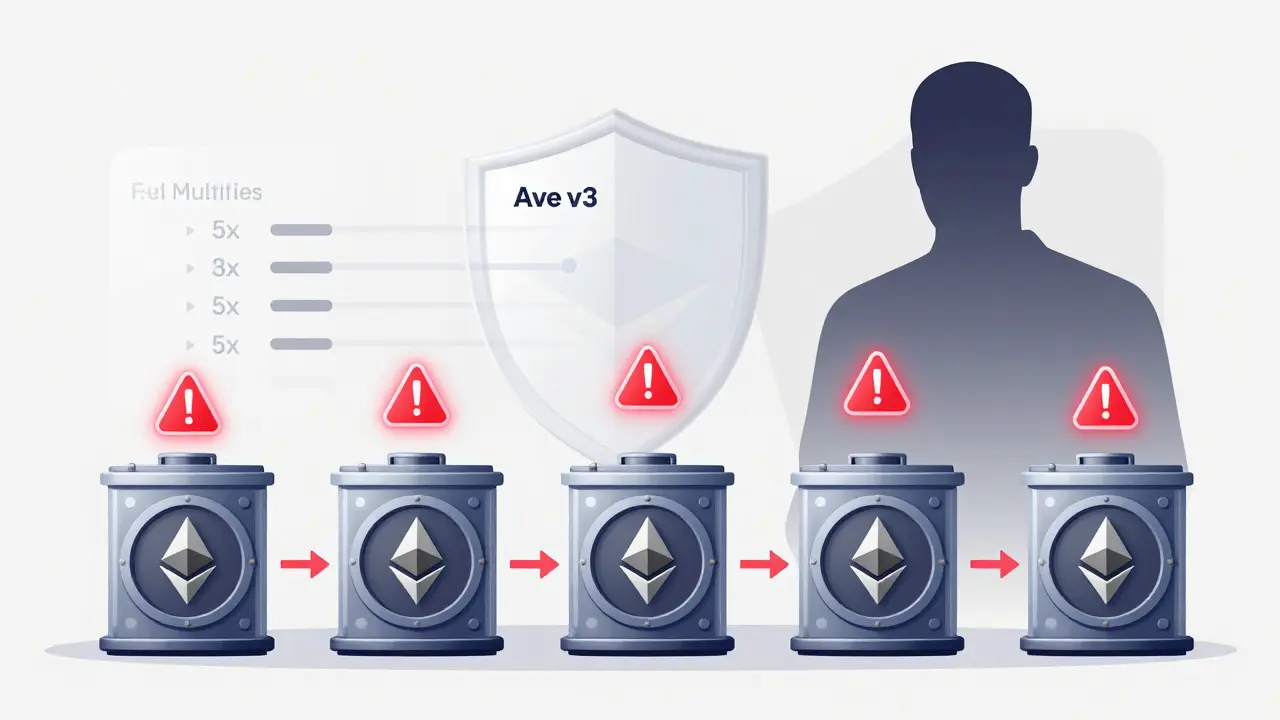
Rehypothecation isn’t new. It’s been around in traditional finance for decades. Think of it like this: you give your car as collateral for a loan. The bank then uses that same car as collateral to borrow money from another bank. Now, your car is backing two loans at once. That’s rehypothecation. In crypto, it works the same way-but without any legal safety nets. In DeFi, when you deposit ETH or USDC into a lending protocol like Jupiter Lend or Aave, the protocol doesn’t just sit on it. It uses your deposit to secure loans for other users. Sometimes, those borrowed assets get deposited into another vault, and reused again. This creates a chain of collateral dependencies. One asset ends up backing five, ten, even twenty loans. The math sounds great: more efficiency, higher yields. But when the market dips, the whole chain can snap.How DeFi Turns Collateral Into a House of Cards
Traditional banks have rules. In the U.S., Regulation T limits rehypothecation to 140% of a client’s liability. In Europe, the 2003 Financial Collateral Directive sets clear boundaries. DeFi has none of that. Protocols claim they’re "decentralized" and "transparent," but many still reuse collateral without telling users. Take Jupiter Lend. Their marketing said "isolated vaults"-meaning your assets were separate from everyone else’s. But in August 2024, during a 15% market drop, their system froze $42 million in user funds. Why? Because one vault’s liquidation triggered a cascade. The collateral from Vault A was backing loans in Vault B, C, and D. When Vault B got hit, the system couldn’t unwind the dependencies fast enough. Users who thought they were safe suddenly couldn’t access their own assets for over 72 hours. This isn’t a bug. It’s by design. Smart contracts automate reuse. There’s no human checking if it’s safe. Just code executing rules written by developers who prioritized yield over safety.The Hidden Leverage Numbers Don’t Lie
Here’s what the data shows:- 83% of major DeFi lending protocols use some form of rehypothecation (Chainalysis, Q3 2024)
- 92% of these protocols don’t clearly disclose rehypothecation in their terms (Smart Contract Research Forum, 2024)
- During the March 2023 crypto crash, protocols with aggressive rehypothecation saw an average 68% collateral shortfall
- 78% of protocol insolvencies during the May 2021 crash were directly tied to hidden leverage chains (Blockchain Transparency Institute)
Who’s Saying What? Experts Weigh In
U.S. SEC Chair Gary Gensler called DeFi rehypothecation "systemic risk comparable to pre-2008 money market funds." That’s not an exaggeration. The same dynamics that collapsed Lehman Brothers-hidden leverage, interconnected exposures-are now in DeFi, but with even less oversight. On the other side, Vitalik Buterin believes properly designed rehypothecation with circuit breakers can be safe. He points to MakerDAO’s limited reuse model as a template. And he’s right-some protocols are trying. Aave v3 now shows exact collateral reuse ratios in each isolated pool. Compound added circuit breakers that pause cross-vault lending during volatility. These aren’t perfect, but they’re steps toward transparency. Meanwhile, Dr. Linda Yueh from Bloomberg called the "isolated vault" marketing a "false sense of security." And she’s not wrong. A survey of 1,247 DeFi users found 68% had unexpected liquidations-and 82% of those were in protocols that didn’t disclose rehypothecation.How to Protect Yourself
You can’t avoid DeFi. But you can avoid getting burned. Here’s how:- Read the fine print-not the marketing. Look for terms like "collateral reuse," "cross-vault liquidity," or "shared backing." If it’s not mentioned, assume it’s happening.
- Use blockchain explorers. Tools like Etherscan let you trace how collateral moves between vaults. If your ETH appears in three different loan contracts, you’re part of a reuse chain.
- Stick to protocols with clear disclosures. Aave v3, MakerDAO’s new single-collateral vaults, and protocols using the DeFi Safety Council’s new disclosure framework are your safest bets.
- Keep your loan-to-value ratio below 65%. Higher leverage means more liquidation risk. During volatility, even 70% can be deadly.
- Diversify your collateral. Don’t put all your assets in one protocol. Spread them across platforms with different risk profiles.

The Bigger Picture: Regulation Is Coming
The SEC fined Jupiter Lend in February 2025 for misleading disclosures. That was the first time a DeFi protocol was penalized specifically for hiding rehypothecation. ESMA in Europe is now pushing similar rules. By 2026, we’ll likely see mandatory risk labeling on all DeFi lending interfaces. But until then, you’re on your own. Institutional investors already avoid opaque protocols-92% of their DeFi allocations went to transparent platforms in Q3 2024 (Galaxy Digital). If big money is running from hidden leverage, you should too.What’s Next?
Ethereum’s upcoming EIP-7272, set for Q2 2025, will let wallets natively track collateral reuse chains. That’s a game-changer. Imagine your wallet showing: "Your 5 ETH is currently backing 8 loans across 3 protocols." No more guessing. The World Economic Forum is also working on a "Rehypothecation Risk Index" expected in Q1 2026. Think of it like a credit score for DeFi protocols-based on how dangerously they reuse your assets. For now, the message is simple: transparency saves your money. If a protocol won’t tell you how your collateral is being used, don’t trust it. The system was built to maximize yield. But your safety shouldn’t be a trade-off.Is rehypothecation the same as collateral reuse?
Yes, in DeFi, the terms are used interchangeably. Rehypothecation specifically refers to a financial intermediary (like a DeFi protocol) reusing client assets as collateral for other transactions. Collateral reuse is the broader term, but in practice, they describe the same risky behavior: one asset backing multiple loans.
Can I see if my assets are being rehypothecated?
Yes-but it takes work. Use Etherscan or similar blockchain explorers to trace your deposited tokens. If your ETH appears in multiple lending contracts across different vaults, it’s being reused. Protocols like Aave v3 now show this directly in their interface. If yours doesn’t, assume the worst.
Why don’t DeFi protocols just stop rehypothecation?
Because it makes their yields look better. Higher collateral reuse = more loans issued = more interest earned. Protocols compete on APY. If one platform offers 12% and another offers 18% using hidden leverage, users will flock to the higher yield-even if they don’t realize they’re taking on massive risk.
Are there any DeFi protocols that don’t use rehypothecation at all?
Yes, but they’re rare. Protocols like MakerDAO’s new single-collateral vaults and some smaller, community-run lending pools avoid reuse entirely. These platforms sacrifice yield for safety. They’re slower to grow, but they’ve never had a major collapse. If you want zero rehypothecation risk, look for protocols that explicitly state: "No collateral is ever reused beyond the original loan."
What happened during the Jupiter Lend incident?
In August 2024, a 15% market drop triggered a liquidation cascade. Jupiter Lend claimed its vaults were isolated. But in reality, collateral from one vault backed loans in 14 others. When one vault failed, the system couldn’t unwind the dependencies fast enough. $42 million in user funds were frozen for over 72 hours. 14,382 users were affected. The SEC fined Jupiter Lend $12 million in February 2025 for misleading marketing.
Is rehypothecation risk higher in stablecoins or ETH?
It’s higher in ETH and other volatile assets. Stablecoins like USDC or DAI are less risky because their price doesn’t swing. But protocols often reuse stablecoins as collateral for volatile loans (like ETH or SOL). That means even your "safe" stablecoin deposit could be backing a high-risk loan. The risk isn’t in the asset-it’s in how many times it’s reused.

Comments (9)
Rahul U. March 2 2026
Really appreciate this breakdown-finally someone explained rehypothecation in a way that doesn’t sound like a Wall Street jargon salad. 🙌 I’ve been using Aave v3 for months and was skeptical about the "isolated vaults" claim until I checked Etherscan. Turns out my USDC was showing up in 3 different loan contracts. Scary stuff. Glad they’re finally disclosing reuse ratios now. Still, I’d rather earn 8% safely than 15% and sleep with one eye open. 💡
E Jones March 3 2026
LET ME TELL YOU SOMETHING, MY FRIENDS-THIS ISN’T JUST REHYPOSTHICATION, THIS IS A FULL-ON COORDINATED ATTACK BY THE FED, THE IMF, AND THE DARK WEB’S SECRET DEFI CULT THAT WANTS TO STEAL YOUR CRYPTO AND TURN YOU INTO A DIGITAL SERF. THEY’RE USING AI-DRIVEN COLLATERAL LOOPS TO CREATE A BACKDOOR IN ETHEREUM’S BLOCKCHAIN-AND THEY’RE HIDING IT BEHIND "TRANSPARENCY" LABELS LIKE A CLOWN HIDING A KNIFE IN A CUPCAKE. I’VE SEEN THE PAPERWORK. I’VE TALKED TO THE WHISTLEBLOWERS. THEY’RE CALLING IT "THE LEND-CHAIN CONSPIRACY." AND THEY’RE NOT STOPPING AT 5X LEVERAGE-THEY’RE GOING TO 20X BY Q3 2025. YOU THINK YOU OWN YOUR ETH? YOU OWN NOTHING. YOU’RE A DATA POINT IN A MATRIX OF MORTGAGED ASSETS. WAKE UP.
Barbara & Greg March 3 2026
While the technical exposition is commendable, I must express profound concern regarding the ethical underpinnings of protocols that prioritize yield over fiduciary responsibility. The normalization of rehypothecation reflects a broader cultural decay in financial ethics-a descent into transactional nihilism where trust is replaced by algorithmic opacity. One cannot reasonably claim decentralization while systematically obscuring the fundamental mechanics of asset usage. This is not innovation; it is institutionalized predation dressed in smart contract clothing. The absence of regulatory oversight is not a feature-it is a moral failure.
selma souza March 4 2026
"Rehypothecation isn’t new." Actually, it’s spelled "rehypothecation"-one word, no hyphen. And "decentralized" should not be capitalized unless it’s at the start of a sentence. Also, "$42 million" needs a space before the dollar sign in formal writing. And you said "vaults" plural but then referred to "Vault A"-capitalized like a proper noun? That’s inconsistent. And don’t get me started on "Ethereum’s upcoming EIP-7272"-you didn’t even italicize the EIP number. This is amateur hour. Fix your grammar before you fix DeFi.
Frank Piccolo March 6 2026
Look, I don’t care if your ETH is backing 12 loans. If you’re in DeFi, you signed up for risk. The whole point is to outsmart the banks, not whine about collateral chains. Meanwhile, China’s got their CBDC rolling out and we’re over here debating whether a 15% drop in ETH is a "systemic risk." Get real. Also, who the hell is Dr. Linda Yueh? Sounds like a Bloomberg intern who got promoted after writing a LinkedIn post. If you want safety, go buy T-bills and stop pretending crypto is your retirement plan.
James Boggs March 7 2026
Excellent summary. I’ve been tracking collateral flows on Etherscan for my own deposits and found the same pattern-my USDC ended up in three different protocols. It’s eye-opening. Aave v3’s transparency is a breath of fresh air. I’ve since migrated 80% of my position there. Happy to share my wallet view if anyone wants to learn how to trace it. Safety first, yield second.
Addison Smart March 7 2026
There’s something deeply human about this whole situation. We built DeFi to be free, open, and fair-but somewhere along the way, we traded autonomy for convenience. We wanted higher yields, so we ignored the fine print. We told ourselves "it’s decentralized," so we didn’t need to understand it. But now we’re seeing the consequences: a house of cards built on trust we never bothered to verify. I’ve lived in five countries, and I’ve never seen a financial system where the users were so eager to be exploited as long as the numbers looked good. Maybe the real innovation isn’t in the code-it’s in the culture. We need to relearn how to read, how to ask, and how to say "no" when something feels too good to be true. Because it always is.
David Smith March 8 2026
THIS IS WHY I QUIT CRYPTO. I KNEW IT WAS A SCAM FROM DAY ONE. THEY’RE ALL LYING. "ISOLATED VAULTS?" MORE LIKE "ISOLATED LIES." I DEPOSITED 10 ETH INTO JUPITER LEND AND THEY TOOK IT, LOANED IT OUT, THEN LIQUIDATED ME FOR A 12% DROP. I LOST $30K. THEY SAID IT WAS "AUTOMATED." BUT IT WASN’T AUTOMATED-IT WAS DESIGNED TO FAIL. AND NOW THEY’RE TRYING TO SELL US "DISCLOSURE" LIKE IT’S A FEATURE? IT’S A COVER-UP. THE SEC IS JUST A FEW YEARS LATE. I’M MOVING TO PARAGUAY. AT LEAST THEY DON’T LIE ABOUT THEIR BANKS.
Lissa Veldhuis March 9 2026
I knew this was coming. Everyone who didn’t read the whitepaper is now crying. LOL. You think you’re smart for using Etherscan? I traced my collateral back to a DAO that was secretly using my DAI to back a Solana leveraged position. You’re not safe. You’re never safe. And now you’re mad? You should’ve done your homework. This isn’t a bug. It’s a feature of your laziness.