

When Bitcoin drops 20% in a day, most traders panic. Sell too early? You miss the rebound. Hold on? Your account gets hammered. But there’s a quiet, powerful tool most beginners overlook: stablecoin pairs. Instead of trading Bitcoin against USD or EUR, smart traders trade BTC against USDT, USDC, or DAI. Why? Because these stablecoins hold their value close to $1 - even when everything else is falling apart.
What Are Stablecoin Pairs and Why Do They Matter?
A stablecoin pair means trading one cryptocurrency against a stablecoin instead of another volatile asset. For example, BTC/USDT isn’t Bitcoin vs. Ethereum - it’s Bitcoin vs. a digital dollar. That’s the key difference. When you buy BTC with USDT, you’re not betting on the dollar’s value. You’re betting only on Bitcoin’s movement. And if Bitcoin crashes? You can sell BTC for USDT in seconds and lock in your remaining value - no bank transfers, no waiting days for cash to clear. This isn’t theory. In November 2021, Bitcoin lost 65% of its value in weeks. Traders using BTC/USD pairs had to wait 3-5 business days to cash out through banks. Those using BTC/USDT? They sold, converted to USDT, and sat tight - no losses from timing delays. According to Chainalysis, stablecoin pair volume jumped 220% during that crash. People weren’t just trading - they were surviving.How Stablecoins Keep Their Value (And When They Don’t)
Not all stablecoins are built the same. There are two main types: fiat-backed and algorithmic. Fiat-backed stablecoins like USDT and USDC are supposed to be worth $1 because they hold $1 in real cash or short-term U.S. Treasuries for every coin issued. Circle, the company behind USDC, publishes monthly reports showing exactly what’s in their reserves. As of March 2023, they held $41.1 billion in assets backing USDC. That’s transparency. Tether (USDT) is different. For years, it claimed to be fully backed but never showed full proof. In 2021, it settled with the CFTC for $4.1 billion after admitting it wasn’t always 1:1 backed. Today, it’s still the most traded stablecoin - about 68% of the market - but many professionals avoid it for that reason. Then there’s DAI, an algorithmic stablecoin. It doesn’t hold cash. Instead, it locks up more than $1.50 worth of Ethereum or other crypto for every $1 of DAI created. If crypto prices drop, the system automatically sells collateral to keep DAI stable. It’s clever - but risky. If the whole crypto market crashes at once, DAI can struggle to stay pegged. The worst case? TerraUSD (UST). In May 2022, it broke its $1 peg and collapsed. Within hours, $40 billion in market value vanished. Traders who held UST/BTC pairs lost everything. The lesson? Don’t trust a stablecoin just because it’s popular. Check its backing.The Real Benefits: Slippage, Speed, and Liquidity
Stablecoin pairs aren’t just about safety. They’re faster, cheaper, and deeper than trading against fiat. Take slippage - the difference between the price you see and the price you get. On volatile pairs like ETH/BTC, slippage can hit 2% during busy times. On BTC/USDT? It’s usually under 0.1%. That’s because USDT pairs have over $500 million in order book depth on major exchanges like Coinbase Pro. You can trade $100,000 without moving the market. Speed matters too. Sending USD from your bank to Kraken takes 2-4 days. Converting BTC to USDT on Binance? Under 15 seconds. That’s why high-frequency traders and arbitrage bots rely on stablecoin pairs. They’re the fuel. And liquidity? USDT/BTC is the most traded pair on Earth. More buyers and sellers mean tighter spreads, better fills, and fewer surprises. A 2023 Flipster.io study found BTC/USDT had 3.2 times more liquidity than BTC/USD on Kraken. That’s not a small edge - it’s the difference between making money and eating fees.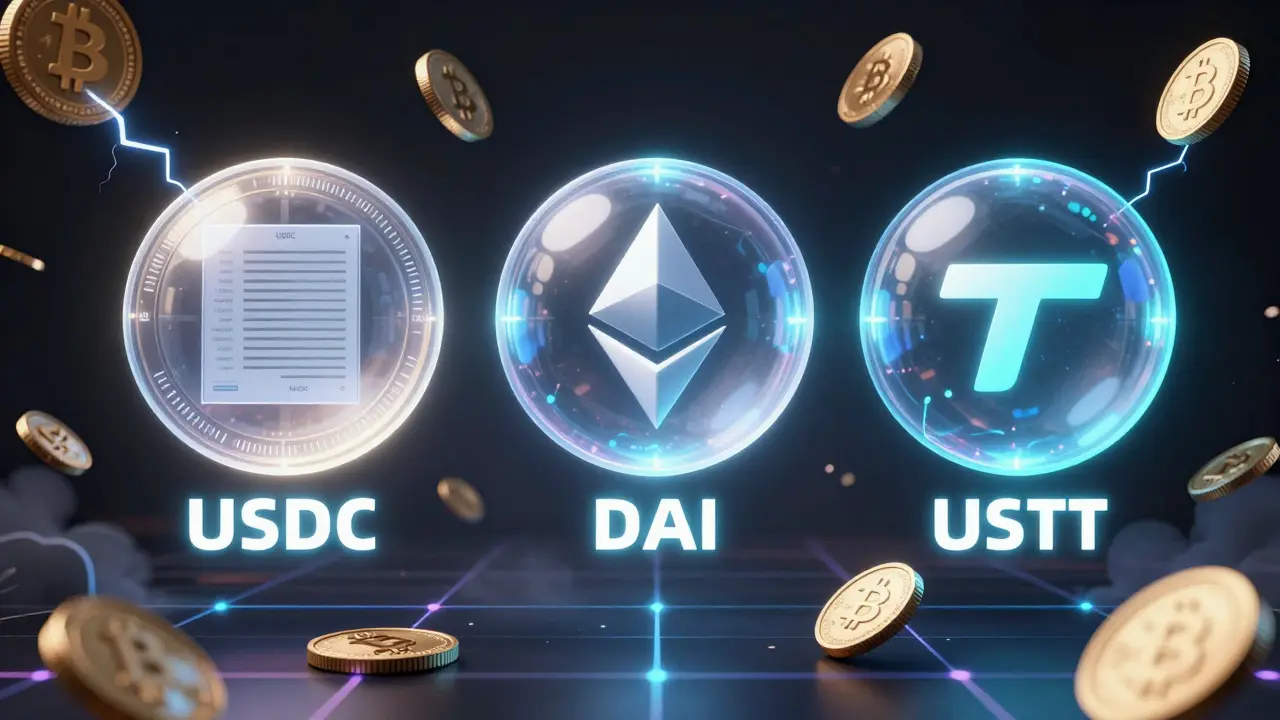
Who Uses Stablecoin Pairs - And How
Retail traders use them to dodge crashes. Professional traders use them to move in and out of positions without leaving the crypto ecosystem. Imagine you’re holding Ethereum. You think it’s overbought. You don’t want to sell to USD and pay taxes or wait for a bank transfer. So you swap ETH for USDC. Now you’re out of volatility. You wait. When ETH drops 30%, you buy back in - all within minutes. No bank, no paperwork, no delay. Hedge funds do the same. Fidelity’s 2023 survey found 68% of institutional crypto allocations use USDC pairs. Why? Because regulators look more kindly on USDC than USDT. And if you’re managing $100 million, you can’t afford to get caught in a de-pegging event. Even decentralized finance (DeFi) runs on stablecoin pairs. Curve Finance, a top DeFi protocol, has over $5 billion locked in stablecoin pools. Why? Because yield farmers need stable assets to earn interest without getting wiped out by price swings.The Hidden Risks You Can’t Ignore
Stablecoin pairs aren’t magic. They come with real dangers. First, counterparty risk. If Circle or Tether goes under - or gets frozen by regulators - your USDC or USDT could become worthless overnight. That’s what happened in March 2023 when Silicon Valley Bank collapsed. USDC briefly dropped to $0.85. It recovered, but it took 72 hours for Circle to process redemptions. Traders who needed cash fast were stuck. Second, regulation. The U.S. SEC is cracking down. In 2023, they sued Binance and Coinbase for listing unregistered stablecoins. If USDT gets delisted on major exchanges? Its value could crater. That’s not speculation - it’s legal reality. Third, overconfidence. Some traders think stablecoin pairs make them invincible. They don’t. If you’re leveraged 50x on BTC/USDT and Bitcoin drops 5%, you’re liquidated. The pair doesn’t protect you from bad leverage - it just removes one layer of risk.How to Use Stablecoin Pairs the Right Way
Here’s what works in practice:- Use USDC over USDT - It’s more transparent, regulated, and trusted by institutions. Even if it’s less liquid, the safety premium is worth it.
- Keep multiple stablecoins - Don’t put all your cash in one. Use USDC, DAI, and FDUSD. If one fails, others hold.
- Check reserve reports - Circle’s website shows real-time USDC backing. Tether’s transparency? Still sketchy.
- Avoid low-volume pairs - Don’t trade SOL/UST or LTC/DAI if daily volume is under $5 million. Slippage will eat you alive.
- Set up alerts - If USDC drops below $0.98 or USDT rises above $1.02, you need to act. Use TradingView to monitor peg deviations.
- Use stop-losses - Even with stablecoin pairs, set a 1-2% stop-loss on your position if the peg breaks. It’s insurance.
What Comes Next? The Future of Stablecoin Pairs
The EU’s MiCA law, effective June 2024, will force all stablecoins to be fully backed and audited monthly. The U.S. is moving toward similar rules. That means USDT’s dominance will shrink. USDC, FDUSD, and other regulated stablecoins will grow. By 2027, the European Central Bank predicts 95% of crypto trading will happen via stablecoin pairs. That’s not a guess - it’s the logical endpoint. Why trade in fiat when you can trade in digital cash that moves at crypto speed? The big banks are watching. JPMorgan says stablecoins are now the ‘cash’ of crypto. Visa is using USDC to settle payments on Solana. The London Stock Exchange is testing stablecoin settlement for tokenized stocks. This isn’t a trend. It’s infrastructure. And if you’re still trading BTC/USD or ETH/EUR, you’re using a 1990s tool in a 2026 market.FAQ
Are stablecoin pairs safer than trading with fiat?
Stablecoin pairs are faster and more liquid than fiat, but not inherently safer. Fiat is backed by governments; stablecoins are backed by companies. If a stablecoin issuer fails or gets frozen (like USDC during the SVB collapse), you can lose access to your funds. For most traders, stablecoin pairs are safer for speed and convenience, but not for absolute security. Use regulated stablecoins like USDC and avoid overexposure.
Can I lose money using stablecoin pairs?
Yes - but not because the stablecoin itself drops. You can lose money if you use leverage, ignore de-pegging events, or trade low-volume pairs with high slippage. The biggest loss came in 2022 when UST collapsed - traders holding UST/BTC lost everything. Always monitor the peg and avoid algorithmic stablecoins unless you fully understand the risks.
Which stablecoin should I use for trading?
For most traders, USDC is the best choice. It’s fully backed, regularly audited by Grant Thornton, and used by institutions. USDT is more liquid but has a history of opacity. DAI is good for DeFi but can de-peg under extreme stress. Avoid lesser-known stablecoins like BUSD or TUSD unless you’re doing deep research. Stick to USDC and USDT for now.
Do I need to pay taxes when converting crypto to stablecoins?
In most countries, converting crypto to a stablecoin is treated as a taxable event - like selling for fiat. The IRS, HMRC, and EU tax authorities consider it a disposal of your crypto asset. You owe capital gains tax on any profit since you bought it. Always track your cost basis and keep records of every swap.
How do I know if a stablecoin is really pegged to $1?
Check real-time prices on CoinGecko or CoinMarketCap. If USDC trades at $0.97 or $1.03 for more than a few hours, it’s de-pegged. Also, visit the issuer’s website - Circle publishes daily reserve reports. Tether’s site shows vague summaries. If you can’t find clear, up-to-date proof of backing, don’t trust it.
Should I use stablecoin pairs for long-term holding?
No. Stablecoins aren’t designed to grow. They’re meant to preserve value during volatility. Holding USDC long-term means you’re earning near-zero interest. If you want to grow wealth, get back into crypto or use yield protocols. Stablecoin pairs are for short-term safety - not long-term gains.
Next Steps for Traders
If you’re new to stablecoin pairs, start here:- Open an account on Binance or Coinbase Pro.
- Buy $100 worth of USDC (not USDT).
- Swap a small amount of BTC or ETH for USDC - just to see how fast it works.
- Set a price alert on TradingView: notify you if USDC drops below $0.98.
- Next time Bitcoin drops 10%, try selling into USDC instead of cashing out to bank.

Comments (12)
Pamela Watson January 7 2026
OMG this is sooo true!! I just sold my BTC for USDT last week when it dipped and I saved like $2k 😭 I used to be so dumb and cashed out to bank and missed the rebound!!
Renea Maxima January 9 2026
Interesting. But isn't this just a glorified way of saying 'don't trust banks, trust corporations'? The real risk isn't volatility-it's the centralization of digital money. We're trading one system of control for another. The blockchain was supposed to free us, not make us dependent on Circle's balance sheet.
Jeremy Chick January 9 2026
Bro this is basic crypto 101. If you're still trading BTC/USD you're literally using a flip phone in 2024. USDT is king. Don't overthink it. Just swap, hold, repeat. Done.
Sagar Malik January 10 2026
While the author articulates a superficially coherent framework regarding stablecoin arbitrage, one must interrogate the ontological underpinnings of algorithmic stability. The DAI protocol, in its reliance on over-collateralization, is fundamentally a Ponzi of liquidity-dependent on perpetual market expansion. And let us not forget the geopolitical vector: USDC’s ties to the Fed’s shadow banking apparatus render it a regulatory honeypot. The true decentralized future lies in non-fiat-backed, trustless reserves-perhaps a synthetic asset derived from decentralized compute power. But alas, the masses are too myopic to see beyond their USD-denominated delusions.
Seraphina Nero January 11 2026
This was super helpful and so clear! I’ve been scared to try stablecoins because I didn’t know which ones were safe. Now I’m gonna stick with USDC and set that alert like you said. Thank you!! 🙏
Megan Ellaby January 11 2026
Wait so if I swap ETH for USDC, is that taxed? I thought only cashing out to bank counted… I’m so confused. Can someone dumb it down? I’m new but wanna learn 😅
Rahul U. January 12 2026
Great breakdown. I’ve been using USDC for 2 years now and never had an issue. Just keep an eye on the reserve reports and avoid anything with ‘algorithmic’ in the name. Also, DAI is fine for DeFi, but for trading? Stick with USDC. Simple.
E Jones January 13 2026
Let me tell you what they don’t want you to know. This whole stablecoin thing? It’s a trap laid by the Fed, the IMF, and the crypto bros who work for them. USDC isn’t safe-it’s a Trojan horse. Circle is owned by a shell company registered in the Caymans that’s funded by BlackRock. They’re building a digital dollar backbone so they can track every transaction, freeze your wallet if you protest, and tax you before you even touch your coins. And when the next collapse happens? They’ll let USDT fail first to scare you into trusting USDC. It’s psychological warfare. The real crypto revolution is dead. We’re just playing in their sandbox now.
Barbara & Greg January 13 2026
It is deeply concerning that the author promotes the use of privately issued digital currencies as a substitute for sovereign monetary instruments. The erosion of public trust in centralized financial institutions does not justify the transfer of monetary authority to unregulated corporate entities. One must consider the systemic risk posed by the concentration of capital and control within a handful of fintech firms. This is not innovation-it is privatization of the monetary commons.
selma souza January 14 2026
"USDT is more liquid but has a history of opacity." You mean "USDT is a fraud"? And you call yourself a "trader"? Also, "FDUSD"? Who even uses that? And "TUSD"? Please. The grammar alone makes me question your credibility. Fix your writing before giving financial advice.
Frank Piccolo January 16 2026
Why are we even talking about this? The US is the only country that matters in crypto. If you're not using USDC, you're not trading. Everyone else is just background noise. Also, why are we still using English? Shouldn't we be speaking in blockchain?
James Boggs January 18 2026
Thanks for the clear, practical guide. I’ve been using USDC for my swing trades and it’s made a huge difference in execution. Highly recommend setting those alerts-caught a 2% de-peg last month and got out before it went further. Simple tools, big impact.