
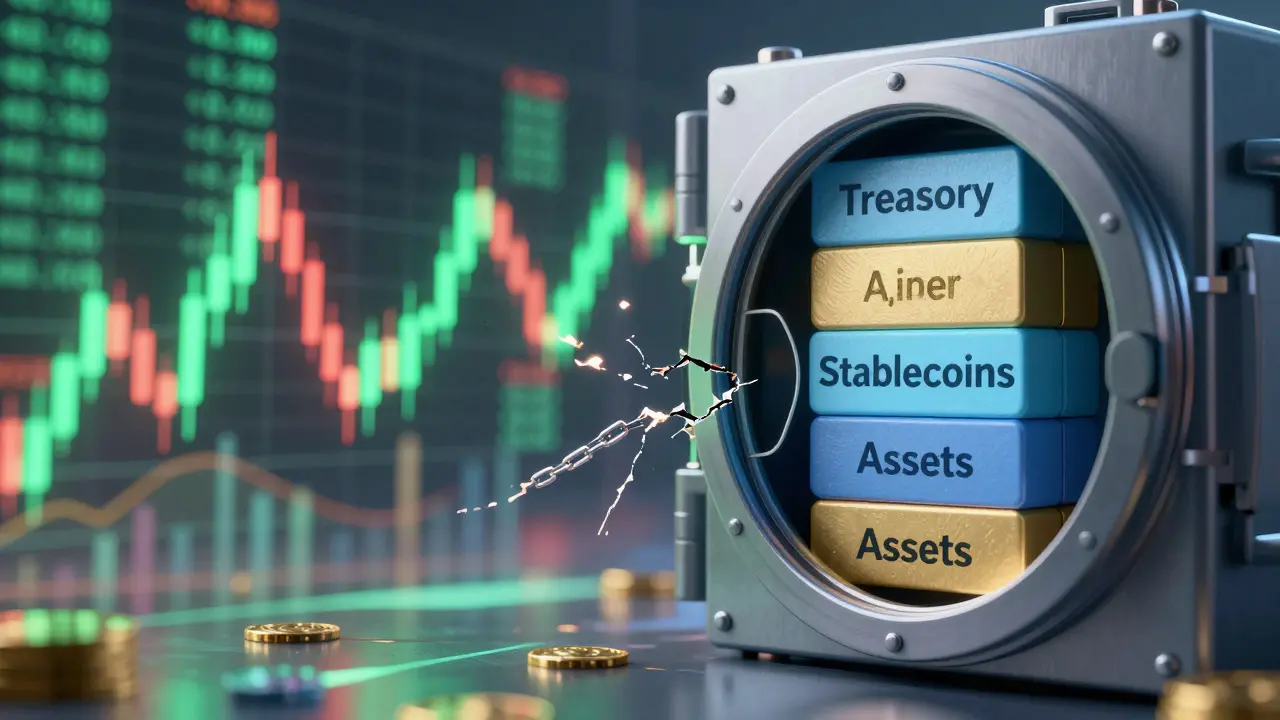
Most people look at an altcoin’s price chart before they care about its bank account. They see a green candle and buy; they see a red one and panic. But behind every protocol is a balance sheet that determines whether it survives the next market cycle or shuts down its Discord server forever. This is the difference between a project with a healthy treasury and one running on fumes.
In the world of Web3, a treasury is the pool of digital assets controlled by a foundation, company, or DAO used to fund payroll, grants, incentives, and operations. It isn't just a pile of coins sitting in a wallet. It's the lifeblood of the organization. The critical metric here isn't just how much money they have, but their runway: the number of months they can sustain planned spending before they must raise more capital or cut costs. If you are investing in or building within the altcoin space, understanding this dynamic is no longer optional-it is survival.
The Anatomy of a Crypto Treasury
A modern altcoin treasury is complex. It rarely consists of just the native token. Instead, it is a diversified portfolio designed to manage liquidity, risk, and operational needs across multiple blockchains. Typically, you will find a mix of the project's own tokens, Ethereum (ETH), Bitcoin (BTC), stablecoins like USDC or USDT, and increasingly, tokenized real-world assets (RWA) such as U.S. Treasuries.
Consider the Uniswap Foundation, a prominent decentralized exchange protocol whose financials offer a transparent look into large-scale treasury management. As of December 31, 2025, Uniswap reported total assets valued at $85.8 million. On paper, that sounds like a fortress. However, breaking down those assets reveals a more nuanced picture: $49.9 million in dollar-denominated assets (mostly non-stablecoin exposure), 15.1 million UNI tokens, and 240 ETH.
This structure highlights a key reality for altcoin projects: holding your own token is risky because its value fluctuates wildly. To pay developers and run marketing campaigns, projects need predictable cash flow. That is why stablecoins and liquid assets are crucial. Without them, a drop in token price doesn't just hurt investors-it stops the lights from turning on at the office.
Calculating Your Real Runway
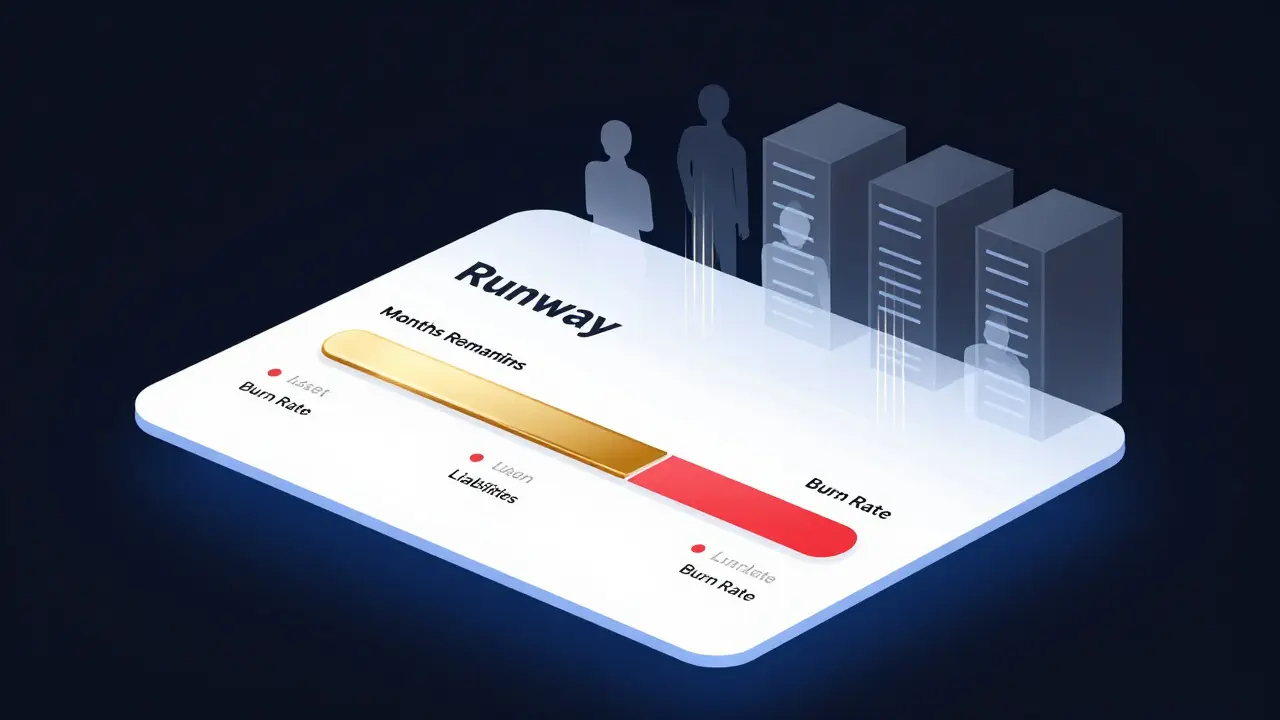
Runway is calculated simply: divide your liquid treasury assets by your average monthly burn rate. The result tells you how many months you have left if nothing changes. But "nothing changes" is a dangerous assumption. You must also account for liabilities-money already promised but not yet spent.
Let's look closer at the Uniswap example. While they had $85.8 million in assets, they also had $106.2 million in future liabilities for grants and incentive programs. Additionally, $26.3 million was earmarked for operating costs and employee token awards. When you factor these commitments in, the foundation projected its operational runway would end around January 2027 without new funding or cost cuts.
This is a classic trap. A high asset number masks a short runway when fixed commitments are high. For altcoin projects, this means you cannot judge funding health by looking at the treasury size alone. You must ask: What is the net position after all known obligations? If a project has $10 million in the bank but has committed $9 million to airdrops over the next six months, their effective runway is much shorter than it appears.
| Metric | Description | Impact on Runway |
|---|---|---|
| Total Assets | Gross value of all holdings (tokens, ETH, stablecoins) | Positive (but misleading if viewed in isolation) |
| Liquid Reserves | Cash-equivalent assets available for immediate spending | Highly Positive (determines short-term survival) |
| Committed Liabilities | Funds pledged for grants, incentives, or salaries | Negative (reduces effective runway) |
| Burn Rate | Average monthly spending on operations and development | Negative (higher burn = shorter runway) |
The Rise of Digital Asset Treasuries (DATs)
A massive shift occurred in 2025 that changed how we view altcoin funding. Companies stopped just raising venture capital to build products and started raising capital specifically to hold crypto on their balance sheets. These are known as Digital Asset Treasuries (DATs). By August 2025, DAT strategies had raised over $15 billion, surpassing the $6-8 billion raised in traditional crypto venture equity deals during the same period.
Why does this matter to altcoin projects? Because these DAT companies are now major holders of the very tokens that populate protocol treasuries. Charles Edwards, founder of Capriole Investments, noted that institutional ownership of Bitcoin grew to around 12% of supply, with demand from ETFs and treasury companies estimated at 500% of daily mine supply. This creates a supportive floor for prices, which helps altcoin treasuries maintain value.
However, there is a catch. Many DATs are moving toward "DAT 2.0," where they act less like passive holders and more like trading desks. They use leverage and yield strategies to boost returns. Edwards warned that roughly 25-26% of these companies were already trading below their Net Asset Value (NAV), meaning the market sees them as riskier than their holdings suggest. If these large entities face margin calls or forced selling, the ripple effect can crash altcoin prices, instantly shrinking the runway of any project heavily exposed to volatile tokens.
Risk Management and Diversification
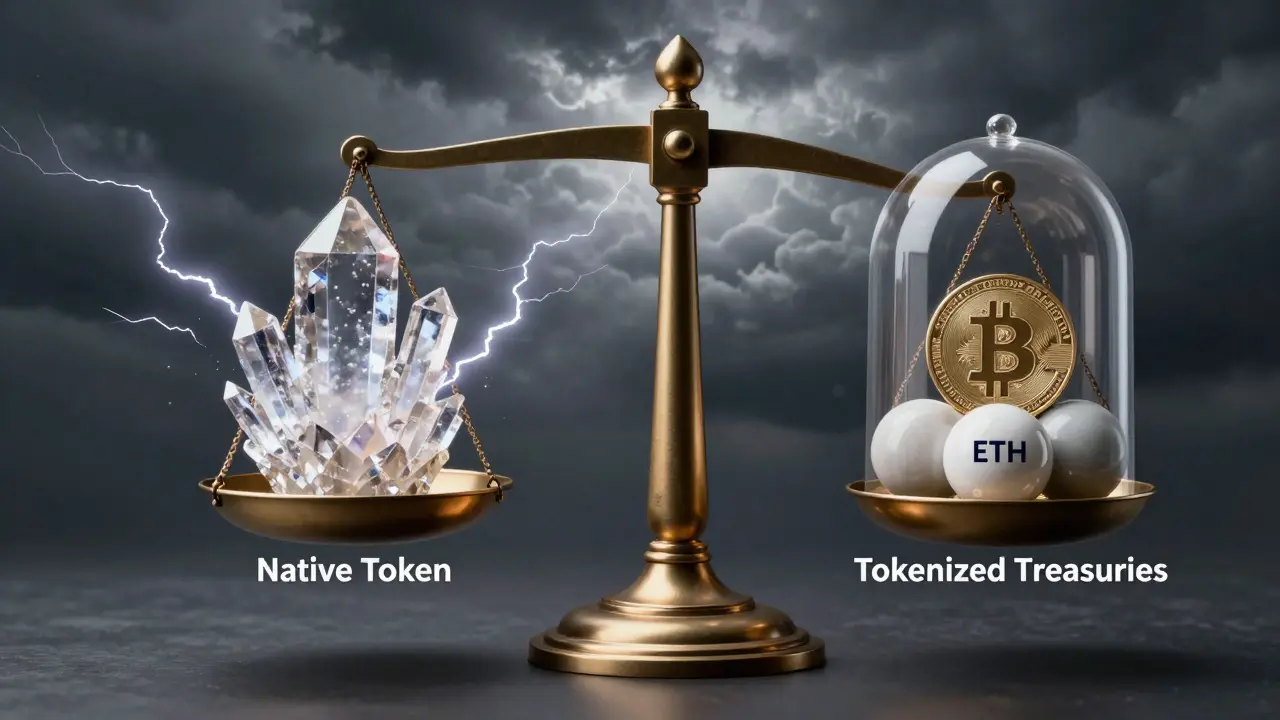
The lesson from the DAT boom is clear: concentration is dangerous. For altcoin projects, relying too heavily on your own token for treasury stability is a recipe for disaster. If the token price drops 50%, your runway is cut in half overnight. Smart treasuries diversify.
We are seeing a trend toward tokenized U.S. Treasuries and other low-volatility instruments. In Q4 2024, the U.S. Treasury Borrowing Advisory Committee began studying the benefits of tokenizing Treasuries, signaling official interest in bringing safe-haven assets on-chain. For a Web3 project, allocating a portion of the treasury to these instruments provides a buffer. It ensures that even if the crypto market crashes, the team can still pay salaries and keep servers running.
Andrew Webley, CEO of Smarter Web, exemplified this cautious approach by keeping only about 5% of his company’s treasury in a single volatile crypto instrument. He argued that this limited exposure reduced systemic risk compared to the aggressive "all-in" models popularized by figures like Michael Saylor. While the Saylor model worked well in bull markets, critics argue it leaves little room for error when markets turn.
Practical Checklist for Assessing Project Health
If you are evaluating an altcoin project, do not just look at the token price. Use this checklist to assess the underlying funding health:
- Check the Asset-Liability Balance: Look for public financials. Does the project disclose its liabilities? A project with $10M in assets and $9M in committed grants is riskier than one with $10M in assets and $1M in liabilities.
- Analyze Token Concentration: What percentage of the treasury is in the native token? High concentration means high volatility risk. Look for diversification into ETH, BTC, or stablecoins.
- Review Yield Strategies: Is the project chasing high yields through complex DeFi protocols? While this boosts nominal returns, it adds counterparty risk. Simple, liquid holdings are often safer for long-term runway.
- Assess Burn Rate Trends: Is the monthly spend increasing or decreasing? A rising burn rate combined with a static treasury signals impending trouble.
- Monitor External Dependencies: Is the project reliant on a specific DAT firm or VC for continued support? If so, what happens if that partner faces financial stress?
Looking Ahead: Sustainability in 2026
As we move through 2026, the funding environment remains robust but increasingly sophisticated. Crypto startups raised nearly $11 billion in 2025, exceeding 2024 totals. Yet, the ease of funding should not lead to complacency. The biopharma sector offers a warning: despite a favorable political climate, traditional financings dropped 59% year-over-year, forcing companies like Artelo Biosciences and MEI Pharma to turn to crypto treasuries to secure R&D runways.
Altcoin projects face similar cyclical pressures. The key to long-term viability is not just raising money, but managing it wisely. Projects that treat their treasury as a strategic tool-balancing growth incentives with operational safety, diversifying away from single-asset risks, and avoiding excessive leverage-will survive the inevitable downturns. Those that chase hype and ignore their burn rate will be the first to fall.
What is a healthy runway for an altcoin project?
A healthy runway is typically considered to be 18 to 24 months. This provides enough buffer to weather market downturns, continue development, and raise additional capital if needed without desperation. Projects with less than 12 months of runway are at significant risk if fundraising conditions tighten.
How do Digital Asset Treasuries (DATs) affect altcoin prices?
DATs act as large-scale buyers of crypto assets, creating sustained demand that can support prices. However, if DATs use leverage or engage in active trading (DAT 2.0), they can also amplify volatility. Their forced selling during market stress can negatively impact altcoin prices, thereby reducing the value of project treasuries.
Why is token concentration in a treasury risky?
Holding a large percentage of the treasury in the project's own native token exposes the organization to extreme volatility. If the token price drops significantly, the project's ability to pay expenses and fulfill grant commitments diminishes rapidly, potentially leading to insolvency even if the technology remains sound.
What role do stablecoins play in treasury management?
Stablecoins provide liquidity and predictability. They allow projects to pay invoices, salaries, and operational costs without worrying about daily price fluctuations. A balanced treasury typically holds a significant portion in stablecoins or other low-volatility assets to ensure continuous operations regardless of market conditions.
How can I find out an altcoin project's treasury details?
Many reputable projects publish regular financial reports or use transparent on-chain tools to display their treasury composition. Look for documents labeled "Financial Report," "Treasury Update," or check platforms like DefiLlama for protocol-specific data. Transparency is a key indicator of a project's commitment to sustainable funding practices.

Comments (11)
Saranya M.L. June 14 2026
The fundamental flaw in this analysis is the assumption that retail investors possess the sophisticated financial literacy required to audit DAO balance sheets. It is frankly amusing to suggest that the average participant should be concerned with 'burn rates' when they are primarily driven by speculative FOMO and meme culture. The Uniswap example provided is textbook corporate accounting masquerading as Web3 transparency, yet it fails to address the systemic liquidity traps inherent in tokenized real-world assets. Furthermore, the reliance on stablecoins introduces counterparty risk that most casual observers completely ignore until a de-pegging event occurs. One must critically evaluate whether these 'treasuries' are merely Ponzi schemes dressed up in blockchain terminology. The narrative of 'runway' is a distraction from the core issue: most altcoin projects lack genuine utility and exist solely to extract value from late-stage entrants. Until we see standardized regulatory frameworks for Digital Asset Treasuries, any discussion of funding health is largely academic and devoid of practical application for the majority of market participants.
om gman June 15 2026
oh look another boring finance bro trying to explain how money works like we dont all know its just numbers on a screen lol
the whole treasury thing is a scam anyway they just hold their own tokens so they can dump on us later classic rug pull mechanics disguised as 'strategy'
Bineesh Mathew June 16 2026
You speak of scams as if morality has any place in the chaotic theater of decentralized finance. The treasury is not merely a bank account; it is the soul of the protocol, often starved by the greed of its creators. When we discuss runway, we are discussing the very breath of life kept alive by the collective delusion of value. Is it not tragic that we measure survival in months rather than in truth? The DATs you mention are but modern alchemists, turning leaden volatility into golden illusions. We are all actors on this stage, pretending that the lights will stay on while the curtain falls. Your cynicism is a shield against the beautiful horror of it all.
Andrea Alonzo June 17 2026
I really appreciate the detailed breakdown here because it highlights something that many people overlook when they are just looking at price charts which is the actual operational sustainability of the project itself. It is quite concerning to see how many teams burn through their capital without a clear path to revenue generation or sustainable growth metrics that would allow them to survive a bear market cycle. I have seen so many promising ideas fail simply because the founders did not understand the importance of diversifying their treasury holdings beyond just their native token which leaves them extremely vulnerable to market fluctuations. It would be incredibly beneficial if more projects adopted the checklist mentioned in the article to ensure they are maintaining a healthy balance between ambitious development goals and prudent financial management practices. Transparency is key here and when a project hides its liabilities or overstates its liquid reserves it creates an environment where investors are essentially gambling rather than making informed decisions based on solid fundamentals.
Francis Laquerre June 17 2026
This is a fascinating perspective on the intersection of traditional finance principles and the wild west of crypto. It reminds me of the early days of venture capital where valuation was often more art than science. The shift towards Digital Asset Treasuries is a cultural evolution in how we perceive value storage. It is dramatic how quickly the narrative changed from 'hodl till death' to active treasury management strategies. We are witnessing the maturation of an industry that was once dismissed as a toy for geeks. The comparison to biopharma funding is particularly striking because it shows that even traditional sectors are looking to crypto for lifelines. This cross-pollination of financial strategies is going to define the next decade of tech investment.
michael rome June 19 2026
It is imperative that we approach this topic with a high degree of seriousness and respect for the complexity involved in treasury management. The data presented regarding Uniswap serves as a critical case study for understanding the nuances of liability management in decentralized organizations. One must consider the ethical implications of committing funds to grants before securing long-term stability. It is my professional opinion that projects failing to disclose their true burn rates are engaging in deceptive practices that undermine trust in the ecosystem. We must advocate for greater transparency and accountability among DAO foundations. Let us remain focused on the facts and avoid emotional reactions to market volatility. A disciplined approach to analyzing runway is essential for anyone serious about participating in this space.
Oskar Falkenberg June 20 2026
i mean yeah obviously u need to check the books but like honestly who actually reads those reports unless ur a whale or something? most of us just buy the dip and hope for the best tbh. the whole dat thing sounds kinda scary tho like what happens if they all sell at once? thats gonna be a mess for sure. i guess we just gotta trust the devs right? lol jk dont trust anyone. but seriously good point about the stablecoins part cause if ur holding only your own token and it crashes 50% ur basically dead in the water so diversification is key i suppose. just wish there was an easier way to track this stuff without needing a finance degree
Caitlin Donehue June 21 2026
I noticed that the article mentions tokenized US Treasuries as a safe haven, which seems interesting given the current economic climate. It makes me wonder how accessible these instruments are for smaller altcoin projects compared to larger foundations like Uniswap. Are there specific platforms that facilitate this kind of diversification for newer protocols?
Stephanie Frank June 22 2026
lol nice try selling this 'financial literacy' soapbox to normies. nobody gives a shit about your runway metrics when the chart is pumping 20% in a day. this is just fear-mongering content designed to make you feel smart while you get rekt by insider trading. keep dreaming about 'healthy treasuries' while the insiders dump on your head. typical cope.
Patrick Dorion June 23 2026
From a philosophical standpoint, the concept of 'runway' is essentially a measure of existential anxiety within a digital entity. It reflects our deep-seated fear of obsolescence. However, practically speaking, the advice is sound. If you are building a protocol, treating your treasury as a strategic asset rather than a prize pool is crucial. The DAT trend is significant because it institutionalizes speculation, turning it into a balance sheet item. This legitimizes crypto in the eyes of traditional finance but also exposes it to traditional risks like margin calls. Diversification isn't just a financial tactic; it's a hedge against the unpredictability of human behavior in markets. So yes, check the liabilities. They tell the story of what the project promises versus what it can deliver.
Jeanne Abrahams June 25 2026
Oh, spare me the lecture on 'survival.' As if any of these projects deserve to survive. I've been watching this circus from Johannesburg, and let me tell you, the 'experts' predicting 2026 sustainability are about as reliable as a weather forecast in a hurricane. You talk about diversification like it's a magic wand. Meanwhile, the same VCs who preach caution are quietly dumping their bags on retail. It's charmingly naive to think that a checklist will save you from the inevitable rug pulls. Keep your 'runway' calculations; I'll stick to laughing at the absurdity of it all.