

You traded Bitcoin in 2021. You staked Ethereum in 2023. And now, staring at your old tax returns, you realize you never reported those gains. Panic sets in. You worry about audits, massive fines, or even jail time. But here is the good news: fixing past crypto tax errors is a common process, and if you act quickly and honestly, you can often minimize-or even eliminate-the penalties.
Tax authorities are getting smarter. With new reporting rules like the US Form 1099-DA starting in 2025 and HMRC’s direct data collection from exchanges in the UK, the days of anonymous crypto trading are over. If you have unreported income or capital gains, waiting for them to find you is the worst strategy. Proactively amending your returns shows good faith and opens the door to penalty relief programs that simply aren’t available once an audit begins.
Why You Need to Act Now
The enforcement landscape changed dramatically between 2024 and 2026. In the United States, the IRS now receives detailed transaction data from brokers via Form 1099-DA. This means they know exactly what you sold and for how much. In the UK, HMRC has begun automatic data collection from crypto service providers, aiming to recover hundreds of millions in unpaid taxes. Canada’s CRA is using AI-driven tools to flag discrepancies in reported income.
If you ignore the issue, the cost goes up. Interest accrues daily on unpaid taxes. Penalties stack up for late filing and late payment. But if you correct the error yourself before they contact you, you qualify as "unprompted." This status is your golden ticket to significantly reduced penalties or full waiver in many cases.
United States: Using Form 1040-X
In the US, the standard way to fix a mistake is by filing Form 1040-X, the Amended U.S. Individual Income Tax Return. This form allows you to correct income, deductions, credits, and filing status.
Key Rules for US Filers:
- Time Limit: You generally have three years from the date you filed the original return (or two years from when you paid the tax, whichever is later) to claim a refund. However, you can file an amended return to report additional income and pay owed taxes at any time, though you won’t get a refund for overpayments outside the window.
- What to Include: Submit a complete amended return for the year in question. Attach updated Schedule D (Capital Gains and Losses) and Form 8949 (Sales and Other Dispositions of Capital Assets). Clearly explain the changes in Part II of Form 1040-X.
- E-Filing: As of 2026, you can e-file amended returns for the current year and up to two prior years using supported tax software. Older years usually require paper filing.
If your error involves willful evasion of large amounts, consider the IRS Voluntary Disclosure Practice, a program for taxpayers who have failed to file returns or report income. This typically covers a six-year look-back period. It requires full cooperation and payment of all tax, interest, and some penalties, but it greatly reduces the risk of criminal prosecution.
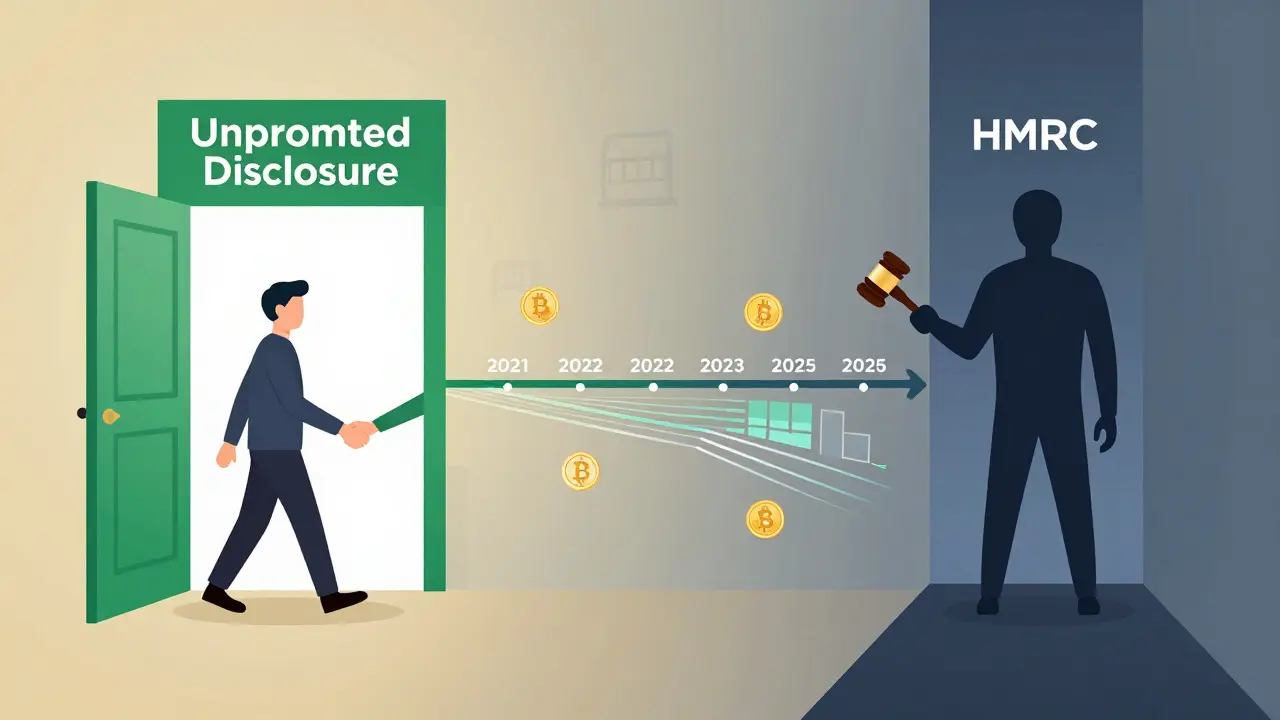
United Kingdom: Self-Assessment Amendments and Disclosure
In the UK, the approach depends on how recent the error is and how careless you were.
Recent Errors (Within 12 Months):
If you missed a deadline or made a mistake on your Self Assessment return, you can amend it online within 12 months of the filing deadline. For example, a 2023-24 return filed by January 31, 2025, can be amended until January 31, 2026. The system will recalculate your tax, interest, and any late-payment penalties.
Older or More Serious Errors:
If the error is older or more significant, you need to use HMRC’s disclosure facilities. The penalty depends on your behavior:
- Innocent Error: Up to 4 years look-back. Penalty range: 0-30% of tax due (if unprompted).
- Careless: Up to 6 years look-back. Penalty range: 0-30% (unprompted) to 15-30% (prompted).
- Deliberate: Up to 20 years look-back. Penalty range: 20-70% (unprompted) to 35-70% (prompted).
- Deliberate and Concealed: Up to 20 years. Penalty range: 30-100% (unprompted) to 50-100% (prompted).
To minimize these, submit an offer through HMRC’s cryptoasset disclosure service before they contact you. Calculate the extra tax, add statutory interest, and estimate the penalty based on the bands above. Being "unprompted" cuts your potential penalty significantly.
Canada: The Voluntary Disclosures Program (VDP)
Canada offers one of the most generous relief structures through the CRA Voluntary Disclosures Program (VDP), a program allowing taxpayers to correct past non-compliance with penalty and interest relief. Updated in September 2025, the VDP distinguishes between unprompted and prompted applications.
General Relief (Unprompted):
If you disclose before the CRA has specific knowledge of your non-compliance, you can get 100% penalty relief and 75% interest relief. This applies to unintentional errors and gross negligence.
Partial Relief (Prompted):
If the CRA has already contacted you or received third-party information about your specific situation, you may still get up to 100% penalty relief, but only 25% interest relief.
Important Note: The VDP requires you to cover the last six years for Canadian-source income and ten years for foreign-source income. You must file Form RC199 and pay the estimated tax owed upfront. Do not wait for an audit letter; once they start investigating, you lose eligibility for General Relief.

Step-by-Step Guide to Fixing Your Returns
Whether you are in the US, UK, or Canada, the preparation steps are similar. Here is how to tackle the mess without losing your mind.
- Gather All Data: Download transaction histories from every exchange, wallet, and DeFi platform you used. Look for CSV exports. If you lost access to an account, check your email for confirmations or use blockchain explorers to trace transactions.
- Use Crypto Tax Software: Manual calculation is prone to error. Tools like Koinly, CoinLedger, or Recap can import your data, calculate fair market value (FMV), determine cost basis, and generate the necessary tax forms (like Form 8949 for the US or SA108 for the UK).
- Identify Taxable Events: Remember, buying crypto isn’t taxable. Selling, swapping, spending, or earning rewards (staking, mining, airdrops) are. Make sure you haven’t missed any income events.
- Calculate Owed Amounts: Run the numbers. Determine the additional tax, plus any interest that has accrued since the original due date.
- File the Amendment: Submit your corrected return. In the US, this is Form 1040-X. In the UK, use the online amendment tool or submit a disclosure offer. In Canada, file amended T1 returns or apply for VDP.
- Pay What You Owe: Pay the tax and interest immediately. This stops further interest accumulation and demonstrates good faith.
Minimizing Penalties: Pro Tips
Penalties are designed to punish negligence and encourage compliance. Here is how to stay on the right side of the law:
- Be Prompt: The sooner you amend, the less interest accumulates. In the UK and Canada, being "unprompted" is crucial for lower penalty rates.
- Be Complete: Don’t cherry-pick. If you missed reporting gains in 2021, report all of them for that year. Partial disclosures can look suspicious and lead to higher penalties.
- Keep Records: Save copies of your amended returns, payment receipts, and correspondence with tax authorities. These prove you acted voluntarily.
- Seek Professional Help: If you owe more than a few thousand dollars, or if your situation involves cross-border assets, consult a tax professional specializing in crypto. They can negotiate with authorities and ensure you maximize relief.
Can I amend my crypto tax return if I already got an audit notice?
If you have already received a formal audit notice or specific contact from the tax authority regarding your crypto activity, you are considered "prompted." In the US, you may still file an amended return, but you likely won’t qualify for voluntary disclosure benefits. In the UK and Canada, your penalty relief options are significantly reduced. It is best to consult a tax attorney immediately to handle the response strategically.
How far back do I need to amend my crypto tax returns?
In the US, you can claim refunds for up to three years, but you should report any unfiled income regardless of age. The IRS Voluntary Disclosure Program typically looks back six years. In the UK, innocent errors go back four years, careless ones six, and deliberate ones up to twenty. In Canada, the VDP requires disclosure for the last six years of domestic income and ten years of foreign income.
Will I go to jail for not reporting crypto gains?
Criminal prosecution for crypto tax evasion is rare and usually reserved for large-scale, willful fraud involving millions of dollars. For most individual investors who made mistakes or omitted small amounts, the consequence is financial-tax, interest, and civil penalties. Proactively amending your return drastically reduces any legal risk.

Comments (10)
om gman July 3 2026
oh look another article telling people to pay their taxes like good little sheep. i bet the author never traded a single satoshi in their life. they probably think crypto is just magic internet money that falls from the sky without any consequences. hilarious how you try to scare us with 'jail time' when we know full well the system is rigged anyway. but sure keep filing your forms and playing by rules written by people who don't understand decentralization at all
Oskar Falkenberg July 3 2026
hey there mate, i actually found this super helpful because i was totally lost on the whole amendment thingy. its really nice to see someone break it down into steps instead of just throwing legal jargon at us. i am currently trying to figure out if my staking rewards from last year count as income or capital gains and this post made me realize i need to sort that out before it gets messy. thanks for sharing this info even if some folks here are being a bit grumpy about it lol
Bineesh Mathew July 4 2026
the very notion of taxation is a theft of one's sovereign liberty yet here we are dancing to the tune of the state because fear has paralyzed our collective consciousness. to amend a return is to admit guilt in a crime that should not exist in the first place. the moral decay of society is evident in our willingness to comply with these draconian measures rather than stand firm in our rights. we have become slaves to the ledger and the chain is forged in gold and silver which is why we must reject the premise entirely and embrace true freedom beyond the reach of governments
Patrick Dorion July 5 2026
as a canadian tax professional i can confirm that the voluntary disclosures program is indeed a lifeline for many clients who were simply overwhelmed by the complexity of early crypto regulations. the key is honesty and completeness as mentioned in the post. i often see people try to hide small transactions thinking they wont be noticed but with blockchain analysis tools available to the cra those days are long gone. it is better to come forward now while you still qualify for penalty relief than wait for an audit letter which changes everything
Caitlin Donehue July 6 2026
i wonder if the software mentioned like koinly or coinledger can handle cross border transactions easily since i lived in three countries during my trading years. it seems complicated to track cost basis when exchange rates were fluctuating so wildly back then. i guess i will have to dig through my old emails to find those csv files which sounds tedious but necessary
Stephanie Frank July 7 2026
this entire guide is basically a confession manual for people who failed to do their basic due diligence. if you cant manage your own financial records you deserve every penny of interest and penalties you owe. stop crying about audits and start acting like responsible adults. the government doesnt care about your panic they care about their revenue stream so get your act together and file the damn form already
Marissa Haque July 8 2026
omg!! i had no idea you could e-file amended returns for up to two prior years!!! that is such a huge relief!!! i was terrified i would have to mail paper forms for everything!!! thank you so much for including that detail!!! it makes the whole process seem less daunting!!! i am going to download my transaction history right now!!!
Keith Barker July 8 2026
time is an illusion but tax deadlines are very real and unforgiving. the past cannot be changed but the present action determines future consequences. fix what you can and let go of the rest. the universe does not punish ignorance only stubbornness.
Lisa Puster July 8 2026
typical foreign nonsense about global tax harmonization. in the united states we have clear laws and procedures for a reason. if you live here you follow our rules period. dont bring your international complications into our domestic tax code. we deal with enough issues without trying to accommodate every overseas trader who thinks they are above the law. stick to the irs guidelines and stop looking for loopholes that do not exist
Jeanne Abrahams July 9 2026
in south africa sars is also cracking down hard on crypto assets so this advice is quite universal really. we call it a 'voluntary disclosure practice' too and the penalties are steep if you wait too long. it is interesting how every country is adopting similar strategies to catch up with the digital economy. perhaps one day we will have a global standard but until then each nation plays its own game with varying degrees of efficiency and fairness