

Imagine you’ve built a killer online course. It’s polished, the content is gold, and your individual students love it. But then a mid-sized tech firm emails you: "We want to train our entire engineering team of 50 people. Can we buy this?" You freeze. Do you sell them 50 single-user licenses? Do you offer a bulk discount that eats your margins? Or do you create a custom enterprise tier they can’t refuse?
This is where corporate training licensing becomes the difference between a hobbyist creator and a serious B2B education business. Selling to companies isn’t just about volume; it’s about value perception, legal structure, and operational ease. If you get the model wrong, you’ll spend more time managing invoices than teaching. Let’s break down how to actually make money from corporate clients without losing your mind.
Why Individual Pricing Fails in B2B Education
Most creators start with consumer-facing pricing: $99 for lifetime access or $29/month subscription. This works for individuals because the decision-maker is also the user. In B2B sales, the buyer (HR Director) and the user (Employee) are different people. They care about different things.
The HR Director cares about budget predictability, reporting capabilities, and scalability. The employee cares about ease of use and relevance. If you try to force a consumer model onto a corporate client, you hit three walls:
- Purchasing Friction: Companies hate buying 50 separate credit card transactions. They need one invoice, net-30 terms, and a purchase order number.
- Onboarding Chaos: Who creates the accounts? If the company has to email you every new hire’s name, you’re now an admin assistant, not a course creator.
- Value Misalignment: A $99 price tag feels cheap to a company spending $10k on training. Paradoxically, too low a price can signal low quality to procurement teams.
You need a model that solves these problems. That’s why seat-based licensing and site-wide agreements dominate the market.
Core Corporate Training Licensing Models
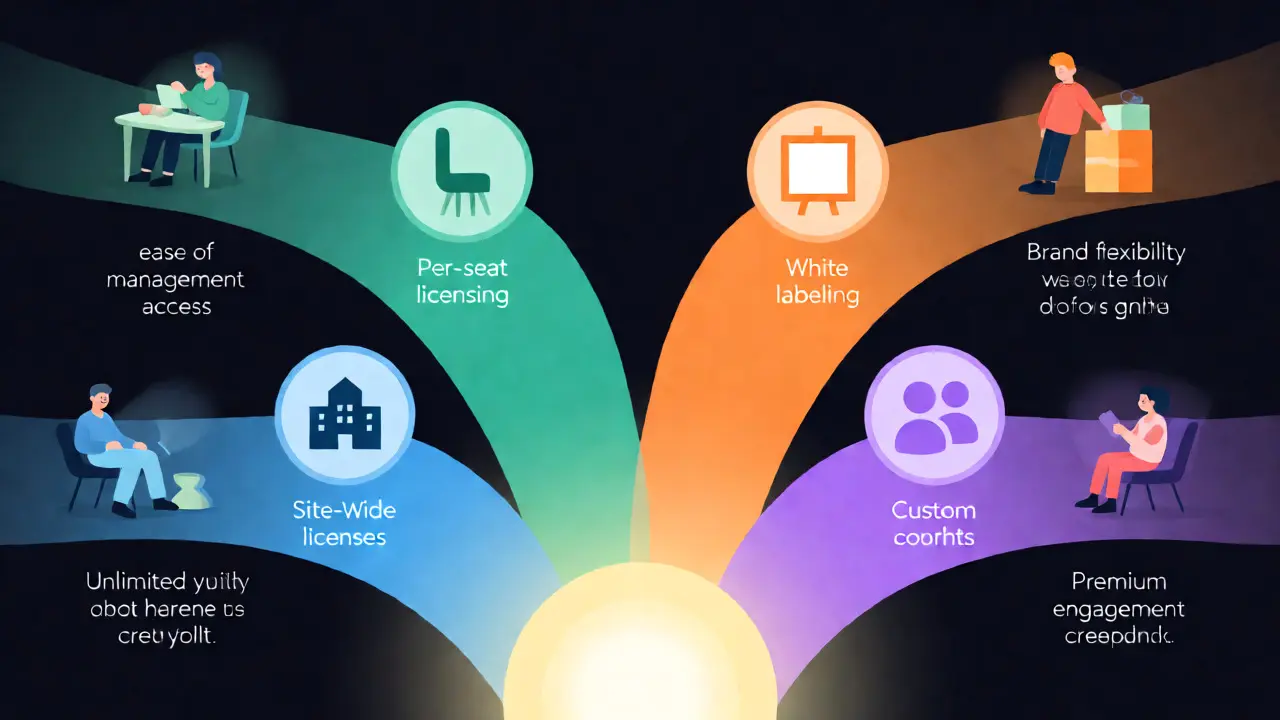
There isn’t one right way to license your content. It depends on your platform, your audience, and your goals. Here are the four most effective strategies used by successful B2B educators in 2026.
| Model | Best For | Pricing Structure | Pros | Cons |
|---|---|---|---|---|
| Per Seat License | Small to Mid-sized Teams (5-50 users) | $X per active user/year | Easy to understand; scales with growth | Admin burden if seats fluctuate wildly |
| Site-Wide License | Large Enterprises (100+ users) | Flat annual fee | Zero friction for hiring/onboarding | Risk of underutilization by client |
| White Label Partnership | Creative Agencies / Consultants | Revenue share or flat wholesale | Access to established client bases | Loss of brand control; lower margins |
| Custom Cohort | Niche Skills / High-Ticket | High fixed fee per group | High margin; premium feel | Not scalable; requires live delivery |
1. Per Seat Licensing: The Standard Approach
This is the most common model. You charge a fee for each person who gets access. To make this work, you need a Learning Management System (LMS) that supports SSO (Single Sign-On) and easy seat management. Tools like Teachable, Thinkific, or specialized B2B platforms like TalentLMS allow admins to add or remove users easily.
Pro Tip: Offer volume tiers. Instead of $100 per seat, structure it as: * 1-10 seats: $120/seat * 11-50 seats: $90/seat * 51+ seats: $75/seat
This encourages larger commitments while protecting your base rate.
2. Site-Wide Licenses: The Enterprise Play
If you’re targeting companies with hundreds of employees, counting seats is annoying for everyone. Instead, offer a site-wide license. The company pays a flat annual fee for unlimited access for all current employees. This removes the friction of adding new hires. Just ensure you define "employee" clearly in your contract (e.g., full-time staff only, excluding contractors).
3. White Labeling: Leveraging Other People’s Audiences
Many consulting firms and agencies have clients but no product. They need training content to upsell their services. You can license your course to them to put under their own logo. This is called white labeling.
For example, a leadership coaching agency might buy your "Management Essentials" course, rebrand it, and sell it to their clients at a markup. You might charge them a flat $5,000 setup fee plus $20 per end-user they enroll. You lose direct customer contact, but you gain massive distribution without marketing costs.
4. Custom Cohorts: The Premium Hybrid
Sometimes, companies want more than videos. They want accountability. Offer a "Cohort-Based" option where a group of 10-20 employees goes through your course together over 6 weeks, with live Q&A sessions. Charge a premium-say $15,000 for the cohort. This blends the scalability of digital content with the high-touch nature of traditional workshops.
Pricing Psychology for B2B Buyers
Don’t just guess a number. B2B buyers operate on ROI calculations. They need to justify the expense to their CFO. Your pricing should reflect the cost of *not* training.
Consider this scenario: A software company spends $50,000 annually on external consultants for basic compliance training. You offer a self-paced course for $10,000/year for their whole team. Even if your content is 80% as good, you’re saving them $40,000. Highlight this savings in your pitch deck.
Also, anchor high. Start your quote with the Site-Wide option ($25,000). When they say it’s too much, offer the Per Seat option ($15,000). Finally, offer the Starter Pack ($5,000). Most will pick the middle option. This is classic anchoring, and it works because it gives them a sense of control over the deal size.
Legal and Contractual Must-Haves
Never send a generic PDF invoice to a corporate client. You need a proper Master Services Agreement (MSA) or a simplified Enterprise License Agreement. Key clauses to include:
- Intellectual Property Rights: Clarify that they are licensing the right to view, not owning the content. They cannot download and resell your videos.
- Usage Scope: Define who can access it. Is it for internal training only? Can they share it with partners?
- Term and Renewal: Is it a one-time payment or annual? What happens if they don’t renew? Do they lose access immediately or after a grace period?
- Data Privacy: If your LMS collects data, ensure you’re compliant with GDPR (crucial here in the UK/EU) and any local data laws.
Keep it simple. A 2-page agreement is better than a 20-page one that scares off small businesses. Use standard templates from legal providers like Rocket Lawyer or local Scottish law firms specializing in IP, but always have a lawyer review your final template.
Operationalizing Your Sales Process
Selling B2B courses is slower than selling to consumers. Expect a 2-6 week sales cycle. Here’s how to streamline it:
- Create a Demo Account: Give prospects temporary access to 2-3 modules. Let them see the interface and content quality firsthand.
- Automate Onboarding: Use tools like Zapier to connect your CRM (HubSpot/Salesforce) to your LMS. When a deal closes, automatically create the account and send login credentials to the admin.
- Provide Success Materials: Send the HR manager a "Manager’s Guide" PDF. How do they track progress? How do they report completion rates? Make them look good to their boss.
Remember, the person signing the check wants to look smart. If your course makes their team more efficient, they win. Frame everything around their success, not your content features.

Common Pitfalls to Avoid
I’ve seen creators burn out trying to accommodate every request. Watch out for these traps:
- Unlimited Revisions: Don’t let big clients demand endless changes to your core content. Set clear boundaries: "Updates included, custom edits billed hourly."
- Payment Delays: Corporates often pay Net-30 or Net-60. Ensure your cash flow can handle this. Consider requiring 50% upfront for large contracts.
- Support Overload: If 50 people email you daily with password resets, you’re overwhelmed. Mandate that all support requests go through one designated admin contact per company.
Final Thoughts on Scaling
Monetizing through corporate licensing isn’t just about raising prices. It’s about shifting your mindset from "teacher" to "solution provider." You’re solving a business problem: skills gaps, compliance risks, or slow onboarding.
Start with one model-likely Per Seat-and refine it. Once you have two or three happy corporate clients, ask for case studies. "How did this training impact your team’s performance?" These stories are your best sales tool. Then, expand into white labeling or site-wide deals as your confidence grows.
The market for upskilling is huge. Companies are desperate for relevant, bite-sized, actionable training. If you package your expertise correctly, you won’t just sell courses-you’ll build recurring revenue streams that survive algorithm changes and platform updates.
What is the average price for corporate training licenses?
It varies widely based on niche and depth. For general soft skills, expect $50-$150 per seat annually. For technical or compliance-heavy topics, prices can range from $200 to $500+ per seat. Site-wide deals for smaller companies often start at $5,000-$10,000 per year.
Do I need a special LMS for B2B sales?
Yes, standard consumer platforms often lack B2B features. Look for systems that support SSO (Single Sign-On), bulk user imports via CSV, detailed reporting/analytics, and invoicing capabilities. Platforms like TalentLMS, Docebo, or even custom WordPress setups with plugins like LearnDash + Restrict Content Pro can work well.
How do I handle refunds for corporate clients?
Unlike consumer purchases, corporate refunds are rare if the service is delivered. Typically, contracts state that fees are non-refundable once access is granted. However, offering a satisfaction guarantee for the first 30 days can help close deals with hesitant buyers.
Can I sell my course to multiple departments in one company?
Absolutely. In fact, this is a great upsell strategy. Once the Marketing department buys seats, approach Sales or Customer Support. Since the infrastructure is already set up, the sales cycle for additional departments is much faster and cheaper.
Is white labeling worth it for solo creators?
It depends on your goals. If you want brand recognition, avoid it. If you want passive income and volume without marketing effort, it’s excellent. Just ensure the partner has a strong reputation, as their brand will be associated with your content quality.

Comments (8)
Zach Loescher September 9 2026
This is a solid breakdown of the friction points in B2B sales. I have been trying to figure out how to handle the Net-30 terms without drowning in administrative work and the Zapier integration tip seems like exactly what I need to automate that onboarding chaos. It feels good to see someone acknowledge that HR directors and employees have completely different priorities because I always struggle to pitch to both groups simultaneously.
Anthony Miller September 10 2026
You are completely missing the point about intellectual property theft which is rampant in this industry. If you do not lock down your content with DRM solutions that actually work then you are just donating your hard work to corporate pirates who will screenshot every single frame of your videos. Your suggestion of a simple two page agreement is laughably naive for any serious enterprise deal where legal teams will tear apart your assumptions until there is nothing left. Do not expect these companies to respect boundaries unless you have teeth in your contract and the willingness to sue them when they inevitably try to share your login credentials across departments that did not pay for access. This entire approach is too soft for the reality of modern corporate greed.
michelle veluz September 11 2026
Wait... wait!!! Did anyone else notice that the author mentioned Scottish law firms?? Why would a US-based creator care about UK GDPR specifically unless they are targeting Europe exclusively?? I feel like there is some hidden agenda here or maybe they are trying to hide the fact that US privacy laws are way more lax so they can get away with charging us more money for less protection!! Also why are we assuming all HR directors want predictable budgets?? Maybe they just want to burn cash before the fiscal year ends!! I am getting suspicious about who really benefits from these "standard" licensing models... it feels like a conspiracy to keep creators poor while corporations hoard the data!!!
Jacob Baby Official September 11 2026
Actually, per seat licensing is already dead if you aren't using AI-driven dynamic pricing models. The market has shifted so drastically that static tiers like $120/$90/$75 are archaic relics that fail to account for real-time demand elasticity. You're essentially leaving money on the table by not leveraging algorithmic adjustments based on user engagement metrics. Most successful platforms now use predictive analytics to adjust prices mid-contract, which makes your fixed fee structure look like something from the stone age. It’s not just about volume; it’s about micro-transactions within the learning path itself. If you stick to these old models, you’re going to be obsolete within eighteen months, guaranteed.
Deb Kortyna, MBA September 12 2026
I must respectfully disagree with the assertion that low pricing signals low quality to procurement teams. In my experience as an MBA graduate working in educational administration, value perception is derived primarily from case studies and measurable outcomes rather than arbitrary price anchors. Furthermore, the suggestion to offer volume tiers is standard practice and hardly innovative. What concerns me most is the lack of emphasis on compliance certifications which are often mandatory for corporate buyers in regulated industries such as finance and healthcare. Without addressing these regulatory requirements, the proposed licensing models may fail to meet basic procurement standards. One should also consider the tax implications of cross-border licensing which can significantly impact net revenue. It is imperative that creators consult with tax professionals before finalizing their international expansion strategies. The oversight of these critical financial details could lead to significant unforeseen liabilities. Therefore, while the operational advice is sound, the financial structuring requires much deeper scrutiny. We cannot simply ignore the complex web of international trade agreements that govern digital goods. Precision in contractual language regarding jurisdiction is equally vital to prevent future litigation. I urge all readers to seek professional legal counsel tailored to their specific geographic markets. Relying solely on generic templates is a gamble that rarely pays off in high-stakes B2B environments. Ultimately, thorough due diligence remains the cornerstone of sustainable business growth.
Quintin Franzese September 12 2026
lol nice try with the "AI-driven dynamic pricing" buzzword salad @Jacob Baby Official but let's be real nobody wants their training cost fluctuating every time they log in. That sounds like a nightmare for budget planning. I prefer the boring flat fee because at least I know what I'm paying for and I don't have to explain to my CFO why the bill changed because three guys watched module 4 twice. Keep it simple stupid works better than fancy algorithms for most small businesses.
Susan Cole September 14 2026
I appreciate the focus on making the HR manager look good. That is a very practical insight that is often overlooked. I will definitely implement the Manager's Guide PDF idea for my next client proposal. It helps to keep things respectful and clear without overpromising on support capabilities.
Savara Gunn September 15 2026
Hey everyone! Just wanted to say this post is super helpful for those of us just starting out. I was totally freezing up when a company asked for bulk licenses last month so reading about the site-wide option gave me some peace of mind. It’s comforting to know that it’s okay to start with one model and grow from there instead of trying to perfect everything at once. Thanks for sharing!