

Imagine sending money to a supplier in Tokyo. You click "send," but instead of arriving instantly, the funds get stuck in limbo for three days. Why? Because somewhere in the chain, an automated system flagged the transaction as suspicious. This isn't just bad luck; it's the reality of modern Cross-Border Payments Compliance, a complex web of rules designed to stop money laundering, terrorist financing, and sanctions violations. For businesses moving money internationally, getting this wrong doesn't just mean delays. It means massive fines, frozen assets, or even criminal charges.
In 2026, the landscape has shifted dramatically. The old days of manual checks are gone. Regulators now demand real-time data sharing, AI-driven monitoring, and total transparency. If you are handling international transactions, you need to understand how Anti-Money Laundering (AML), Know Your Customer (KYC), and sanctions screening work together to keep your business safe.
The Core Pillars: AML, KYC, and Sanctions Explained
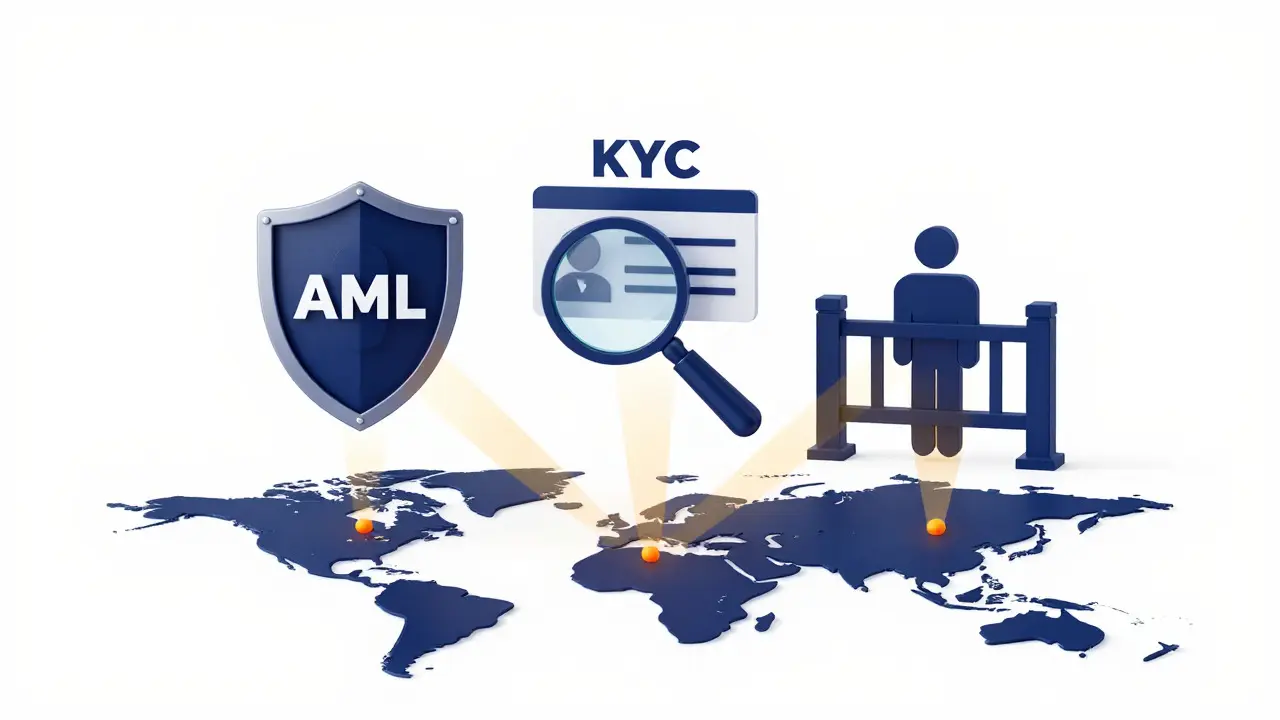
To navigate international finance, you have to speak the language of regulators. Three acronyms dominate every conversation: AML, KYC, and Sanctions. They are distinct but deeply interconnected.
Anti-Money Laundering (AML) refers to the broader framework of laws and procedures designed to prevent criminals from disguising illegally obtained funds as legitimate income. Think of it as the umbrella term. Under AML rules, financial institutions must monitor transactions for unusual patterns. For example, if a small bakery suddenly receives five-figure transfers from unrelated accounts in different countries, that triggers an alert. In the United States, the Bank Secrecy Act (BSA) requires reporting cash transactions over $10,000 via Currency Transaction Reports (CTRs). Failure to report can lead to penalties up to $1 million per violation under U.S. Office of Foreign Assets Control (OFAC) regulations.
Know Your Customer (KYC) is the process of verifying the identity of your clients. You cannot comply with AML if you don't know who you are dealing with. KYC involves collecting personal details, proof of address, and identifying the Ultimate Beneficial Owner (UBO)-the actual human being who owns or controls a company. In the EU, the 6th Anti-Money Laundering Directive (6AMLD), fully enforced by December 2025, mandates strict electronic KYC (eKYC) and digital onboarding. This means no more paper forms; everything must be digitized and verifiable in real-time.
Sanctions Screening is the final gatekeeper. Before any money moves, systems must check names against government blacklists. The most critical list is the Specially Designated Nationals (SDN) list maintained by OFAC. If a customer or their bank appears on this list, the transaction must be blocked immediately. In Q4 2025, Stripe’s real-time screening blocked $47 million in prohibited transactions, showing how vital this layer is. Missing a match here can result in operations being suspended for months, as seen with a UK fintech startup in July 2025.
The Travel Rule and Real-Time Data Sharing
One of the biggest changes in recent years is the FATF Travel Rule. Established by the Financial Action Task Force, this rule mandates that originator and beneficiary information must travel with the payment. No more anonymous wires. As of January 2025, the EU's Transfer of Funds Regulation (TFR) took this further, requiring real-time data sharing within 10 seconds for euro transfers.
This creates a technical tension. On one hand, regulators want all the data. On the other hand, privacy laws like the GDPR restrict how much data you can share across borders. According to Phoenix Strategy Group (2025), this conflict is a major headache for compliance officers. Sixty-eight percent reported difficulties reconciling EU privacy rules with US data collection requirements. To solve this, many firms are adopting ISO 20022 standards, which harmonize data formats so information flows smoothly between banks without breaking privacy laws.
| Feature | United States (FinCEN/OFAC) | European Union (AMLA/6AMLD) |
|---|---|---|
| Primary Oversight | Financial Crimes Enforcement Network (FinCEN) | Anti-Money Laundering Authority (AMLA) |
| KYC Method | Customer Due Diligence (CDD), often manual/hybrid | Mandatory Electronic KYC (eKYC), Digital Onboarding |
| Data Sharing | Suspicious Activity Reports (SARs) confidential | Real-time transfer data required (TFR) |
| Penalties | Up to $1M per violation + criminal charges | Fines up to 10% of annual turnover |
| Beneficial Ownership | Corporate Transparency Act (CTA) registry | Public UBO registers accessible to citizens |
Technology Solutions: AI and Automation
Manual compliance is dead. With global cross-border payments projected to reach $250 trillion by 2027, humans simply cannot review every transaction. That’s where automation comes in. Modern compliance platforms use Artificial Intelligence (AI) to analyze velocity patterns, geographic risks, and behavioral deviations.
According to Alessa's 2025 case studies, AI-driven monitoring reduces false positives by 40%. False positives are those annoying alerts where a legitimate transaction gets flagged, causing delays and frustrating customers. By cutting these down, businesses save time and money. Convera’s 2025 benchmarking showed that automated solutions process transactions 75% faster and reduce compliance staff workload by 60%.
However, implementation is not cheap. Enterprise-grade systems cost between $500,000 and $2 million, according to Gartner's 2025 FinTech report. Small businesses with fewer than 50 international transactions a month might manage with simpler tools, but they face higher risks of non-compliance. Fintech startups handling thousands of transactions monthly almost always need integrated platforms. One user on Reddit’s r/Compliance subreddit noted that while automated KYC cut their onboarding time from 72 hours to 4 hours, the initial setup cost $1.2 million.
Navigating Jurisdictional Conflicts
The world is not regulated uniformly. While the US and EU move toward high-tech, transparent systems, other regions lag behind. Commonwealth of Independent States (CIS) countries, for instance, often rely on paper-based processes with less automated monitoring. This inconsistency creates gaps. Criminals exploit these weak links, leading to what experts call "opaque payment chains."
Data truncation is a common issue. When money passes through intermediary banks, data about the sender or receiver can get stripped out. The Bank for International Settlements (BIS) found that this affects 41% of cross-border transactions. To combat this, the BIS launched Project Mandala, promoting a "compliance by design" architecture. Major banks like JPMorgan Chase and HSBC piloted this framework in Q4 2025. It embeds compliance checks directly into the payment infrastructure, ensuring data integrity from start to finish.
Another emerging challenge is Decentralized Finance (DeFi). DeFi platforms processed $240 billion in cross-border transactions annually in 2025, largely outside traditional compliance frameworks. The IMF’s January 2026 Financial Stability Report warns that this regulatory fragmentation poses a systemic risk. As FATF advances "Travel Rule 2.0" for virtual assets, expect tighter scrutiny on crypto-related payments soon.

Practical Steps for Implementation
If you are building or upgrading your compliance program, start with a risk assessment. Not all customers pose the same threat. Use a risk-based approach, focusing resources on high-risk jurisdictions and transaction types. Here is a checklist to guide you:
- Verify Identities Early: Implement eKYC solutions that verify passports, driver’s licenses, and utility bills in real-time. Ensure you capture the Ultimate Beneficial Owner (UBO) for corporate accounts.
- Screen Against Live Lists: Connect your payment system to OFAC’s SDN list, EU sanctions lists, and UN consolidated lists. Screening must happen before the transaction is approved, not after.
- Monitor for Red Flags: Set up alerts for rapid movement of funds through multiple countries (found in 22% of suspicious transactions), structuring (breaking large sums into smaller ones to avoid detection), and round-tripping (sending money out and back to disguise its source).
- Retain Records Properly: Keep records for at least five years as per BSA requirements. Ensure your storage method complies with GDPR if you handle EU citizen data.
- Train Your Staff: AML/CFT specialists earn $110,000-$150,000 annually because their expertise is valuable. Invest in training so your team understands the latest red flags and regulatory updates.
Remember, compliance is not a one-time project. It is an ongoing process. Regulations change constantly. The EU’s DAC8 and OECD’s CARF frameworks, taking effect in January 2026, require capturing tax-related data alongside AML data. Stay updated, or risk falling behind.
The Future of Cross-Border Compliance
Looking ahead, the trend is clear: more data, more speed, and more integration. Deloitte’s 2025 Financial Crime Report predicts a 92% probability of continued regulatory tightening through 2030. AI will continue to play a bigger role, potentially reducing manual review requirements by 65%. However, this requires significant investment-estimated at $3.2 billion globally through 2027.
For businesses, the message is simple. Ignoring compliance is no longer an option. The costs of non-compliance far outweigh the costs of implementation. By embracing technology and understanding the nuances of AML, KYC, and sanctions, you protect your reputation and ensure your money moves freely across borders.
What is the difference between AML and KYC?
AML (Anti-Money Laundering) is the broad set of laws and procedures aimed at preventing illegal funds from entering the financial system. KYC (Know Your Customer) is a specific process within AML where you verify the identity of your clients. You use KYC to satisfy AML requirements.
How much does it cost to implement a compliance system?
Costs vary significantly based on scale. Small businesses might spend tens of thousands on basic software, while enterprise-grade systems for large fintechs can range from $500,000 to $2 million. Ongoing costs include maintenance, updates, and staffing.
What happens if I miss a sanctions screening?
Missing a sanctions hit can result in severe penalties. In the US, OFAC fines can reach $1 million per violation. Additionally, your banking relationships may be terminated, and you could face criminal charges if negligence is proven.
What is the FATF Travel Rule?
The FATF Travel Rule requires financial institutions to attach originator and beneficiary information to cross-border electronic funds transfers. This ensures that money trails are visible and traceable, reducing anonymity for illicit actors.
How do I handle GDPR conflicts with AML data sharing?
This is a common challenge. You should minimize data collection to only what is necessary for compliance (data minimization principle). Use secure, encrypted channels for data transmission and ensure legal bases for processing are documented. Consulting with legal experts specializing in both GDPR and AML is highly recommended.
