

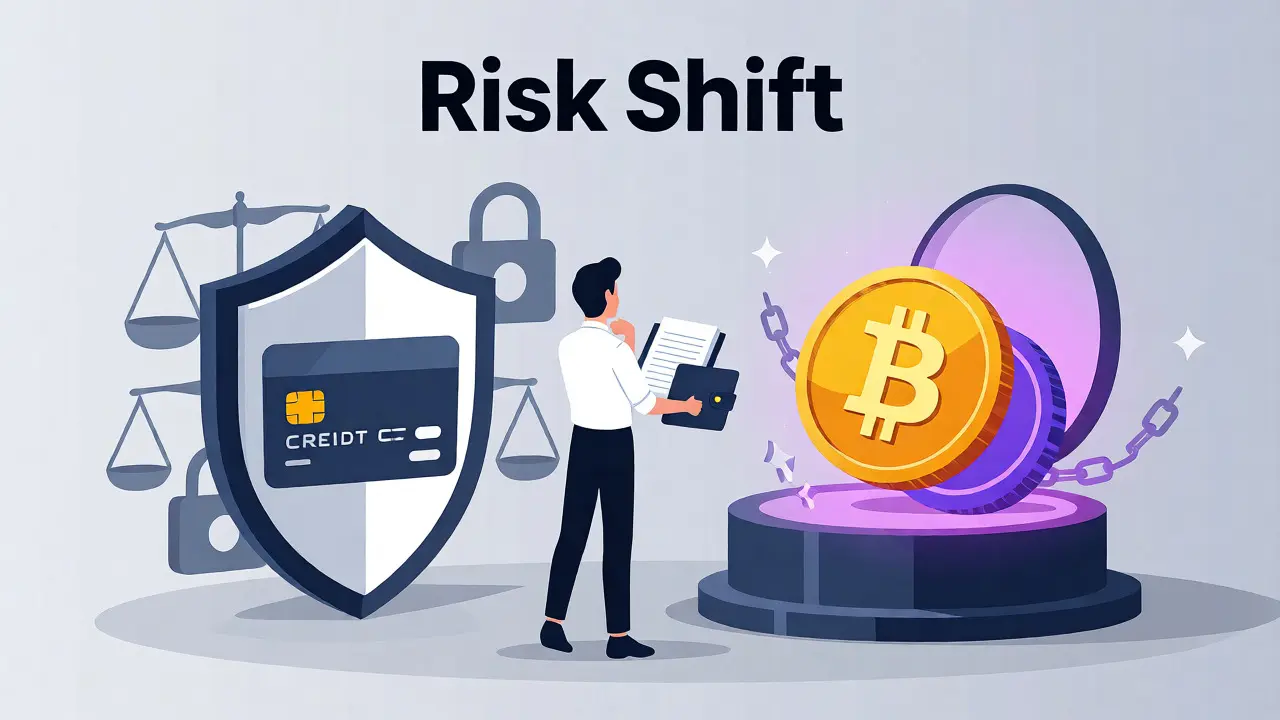
You’ve probably heard the pitch: accept Bitcoin or USDC, cut your processing fees in half, get paid instantly, and never worry about a chargeback again. It sounds like a silver bullet for retail margins. But here’s the catch that most sales decks gloss over: when you remove the card network’s safety net, you also remove their dispute resolution engine. You’re not just changing how money moves; you’re changing who holds the risk.
As of late 2026, merchant adoption of cryptocurrency is growing, but it remains niche in direct retail checkout. Flagship Advisory Partners reported that only 4% of the largest U.S. merchants accepted stablecoins as an e-commerce method recently. Yet, global stablecoin payments hit approximately $70 billion in retail-sized transactions in 2025. Why the gap between volume and merchant uptake? Because the economics are nuanced. The promise of "free" payments ignores network costs, volatility risks, and the operational burden of irreversible transactions. Let’s break down what actually happens to your bottom line when you flip the switch on crypto acceptance.
The True Cost of Crypto Processing
When you compare credit card processing to crypto, the sticker price looks tempting. A typical Visa or Mastercard transaction might cost you 2.8% to 3.5%. In contrast, providers like BitPay advertise rates starting around 1% plus a fixed fee. But is that the whole story?
Your total cost of ownership (TCO) for crypto payments has four distinct layers:
- Processor Fees: This is the percentage charged by the gateway (e.g., BitPay, Coinremitter). Rates vary wildly, from 0.23% at low-cost providers to 2%+ for enterprise solutions with high-risk industry surcharges.
- Network Gas Fees: These are blockchain transaction costs paid to miners or validators. On Ethereum mainnet, these can spike during congestion. On networks like Polygon or Solana, they often stay under $0.01. If you self-custody, you pay this directly; if you use a processor, it may be baked into their spread.
- Conversion Spread: If you want cash in your bank account, someone has to sell the crypto. Processors take a spread on the exchange rate, which acts as a hidden fee. Stablecoins like USDC mitigate this, but redemption routes still carry friction.
- Operational Overhead: Accounting for digital assets isn’t like reconciling a Stripe dashboard. You need records of transaction hashes, timestamps, and fair-market values at the moment of sale for tax purposes.
| Component | Credit Cards | Crypto Processor (e.g., BitPay) | Self-Custody Wallet |
|---|---|---|---|
| Base Fee | ~2.8% - 3.5% | ~1% - 2% + $0.25 | 0% (Processor-free) |
| Network Cost | Included in Base Fee | Variable / Passed Through | Paid Directly (Gas Fees) |
| Settlement Time | 1-3 Business Days | Seconds to Minutes (On-chain) Bank: Daily/Weekly | Instant (On-chain) Bank: Manual Conversion |
| Chargeback Risk | High | None (Irreversible) | None (Irreversible) |
| Volatility Risk | None | Low (if auto-converted) | High (if held) |
Notice the trade-off. You save on the base fee, but you introduce variables that didn’t exist before. For a small business, saving 1.5% on a $50 sale means keeping $0.75 more. Is that worth the potential headache of explaining wallet addresses to a confused customer? For B2B cross-border payments, where wire fees and FX spreads eat 3-5%, crypto savings are substantial.
Settlement Times: Instant Isn’t Always Cash
Marketing materials love the phrase "instant settlement." Technically, a blockchain transaction confirms in seconds or minutes. But does that mean the money is in your operating account? Not necessarily.
There are two types of settlement time here:
- Blockchain Confirmation: The time it takes for the network to validate the transaction. Bitcoin might take 10-60 minutes depending on fees. Ethereum varies by gas price. Stablecoins on Layer-2 networks like Polygon confirm in under 10 seconds.
- Fiat Settlement: The time it takes for your processor to convert the crypto to dollars/euros/pounds and deposit it into your bank. BitPay, for example, offers daily settlement options, but minimum thresholds apply (e.g., 0.01 BTC or 200 USDC).
If you choose immediate conversion, the processor bears the risk of price movement during those few minutes of confirmation. They charge you for that privilege via the spread. If you hold the asset, you wait until you manually decide to sell. During market crashes, holding can feel like watching your revenue evaporate. Most merchants opt for auto-conversion to stablecoins or fiat to neutralize this volatility. This makes the process predictable, but it relies entirely on the processor’s liquidity and uptime.
The Chargeback Myth: Elimination vs. Shift
This is the biggest selling point for many merchants: no chargebacks. With credit cards, a customer can dispute a charge months later, forcing you to provide evidence or lose the funds plus a dispute fee ($15-$25). Crypto removes this mechanism. Once a transaction is confirmed on-chain, it is final. The Federal Trade Commission notes that consumers generally cannot reverse a crypto payment unless the merchant voluntarily refunds it.
Does this mean zero fraud? Absolutely not. It means the nature of fraud changes.
With cards, you deal with "friendly fraud" (buyer’s remorse disguised as unauthorized use) and stolen card numbers. With crypto, you deal with:
- Phishing & Social Engineering: Customers sending funds to a fake address or falling for a scam while paying you.
- Stolen Wallets: If a hacker steals a user’s private key and pays you, the user might claim theft. However, unlike banks, there is no central authority to freeze the funds or reverse the transfer. You keep the money, but you might lose the customer relationship.
- Wrong Network Errors: A customer sends USDC on the Ethereum chain when you expected it on Polygon. Your wallet doesn’t see it. Recovering these funds requires manual intervention and technical expertise.
By eliminating chargebacks, you eliminate the rolling reserves and post-settlement reversals that plague high-risk industries. But you must build your own refund policy. Since you can’t force a reversal, you need clear terms: "All sales final," or "Refunds issued in original asset within 14 days." Ambiguity here leads to support tickets, not lost revenue.
Volatility and the Rise of Stablecoins
Accepting Bitcoin is exciting for brand image, but terrifying for accounting. If you price an item at $100, and the customer pays 0.002 BTC, you have exposure to every tick of the Bitcoin price until you convert it. In 2026, stablecoins like USDC and USDT have become the default for serious merchants. They peg 1:1 to the dollar, removing the volatility headache.
However, stablecoins aren’t magic. They depend on the issuer’s reserves and regulatory standing. In 2025, McKinsey estimated actual stablecoin payments at roughly $390 billion annualized, with significant growth in B2B sectors. But remember: stablecoins are still crypto. They require wallets, network fees, and compliance checks. They don’t solve the "customer doesn’t have a wallet" problem.
Adoption Barriers: Why Your Customers Might Hesitate
Even if the math works for you, does it work for them? A November 2026 NMI survey found that 34% of U.S. adults cite fraud/scams as their top concern with crypto, followed closely by lack of understanding (30%).
Integration complexity is another hurdle. Deloitte reports that 89% of merchants worry about compatibility with existing financial infrastructure. Setting up a crypto payment option isn’t just adding a button to Shopify. It involves:
- Training staff to handle wallet errors.
- Updating accounting software to track digital asset transactions.
- Ensuring legal compliance with local tax laws (IRS treats crypto as property in the U.S.).
If your average ticket size is $20, the friction of opening a wallet app and scanning a QR code might cause cart abandonment. Crypto works best for high-ticket items, digital goods, or customers who already live in the ecosystem.

Implementation Strategy: How to Start Safely
Don’t go all-in. Treat crypto as a pilot program. Here’s a practical rollout plan:
- Choose a Processor, Not Just a Wallet: Unless you have a dedicated dev team, use a hosted solution like BitPay, Coinbase Commerce, or BTCPay Server (for open-source control). They handle the UI, conversion, and basic compliance.
- Start with Stablecoins: Accept USDC or USDT first. Avoid the volatility conversation with your accountant.
- Define Your Refund Policy: Be explicit. Will you refund in USD or the original token? Who pays the network fee for the refund?
- Test Edge Cases: What happens if a customer pays twice? What if they send the wrong amount? Test these scenarios before going live.
- Monitor Reconciliation: Ensure your accounting system can ingest transaction hashes and match them to orders. Mismatched records create audit nightmares.
Who Should Accept Crypto?
Crypto isn’t for everyone. Here’s a quick decision matrix:
| Merchant Type | Recommendation | Reasoning |
|---|---|---|
| Cross-Border B2B | Strong Yes | Avoids wire fees, FX spreads, and slow banking rails. |
| Digital Goods/SaaS | Yes | Instant delivery matches instant payment; no shipping disputes. |
| High-Risk Industries | Yes | Eliminates chargeback fees and reserve holds. |
| Local Retail (Groceries/Coffee) | No | Transaction speed and customer friction outweigh savings. |
| Low-Margin Physical Goods | Caution | Network fees and accounting overhead may erase profit gains. |
The Bottom Line
Merchant acceptance of cryptocurrency is economically credible, but it’s not a universal replacement for cards. The primary benefit isn’t just lower fees-it’s the removal of chargeback risk and faster cross-border settlement. The primary cost is operational complexity and the transfer of dispute responsibility to you.
For most businesses in 2026, the smartest move is a hybrid approach. Keep cards for the mass market. Add stablecoin acceptance for tech-savvy customers, international buyers, and high-value transactions. Use a reputable processor to handle the heavy lifting of conversion and compliance. And always, always write a clear refund policy before you press launch.
Do I have to pay taxes on crypto payments?
Yes. In the United States, the IRS treats virtual currency as property, not currency. You must record the fair market value in USD at the time of the transaction for income recognition. If you hold the crypto and its value changes before you sell, you may also owe capital gains tax. Consult a tax professional familiar with digital assets.
Can customers get their money back if they change their mind?
Not automatically. Unlike credit cards, there is no chargeback mechanism. If a customer wants a refund, you must initiate a new transaction to send the funds back. You should clearly state your refund policy (e.g., "All sales final" or "Refunds in original asset") to manage expectations.
Which cryptocurrencies should I accept?
Most merchants start with major assets like Bitcoin and Ethereum, but stablecoins (USDC, USDT) are increasingly popular because they avoid price volatility. Check what your target demographic uses. Many processors allow you to accept multiple assets but settle in one preferred currency.
What happens if a customer sends the wrong amount?
Payment gateways usually detect underpayments or overpayments. Some allow partial fulfillment or issue a refund for the difference. Others require manual reconciliation. Choose a provider with robust error-handling features to minimize customer service issues.
Is crypto payment secure for my business?
The blockchain itself is secure, but the endpoints (your wallet and the customer's) are vulnerable. Risks include phishing, malware, and human error (sending to the wrong address). Using a reputable processor adds a layer of security through monitoring and insurance, whereas self-custody places full responsibility on you.
